
If a ‘smart agent’ is burning cash, a dumb workflow will usually beat it
Founders are buying “agents” to automate work end to end. The promise is exciting; the bills and failure rates are not. Here’s the pattern we keep seeing across Indian startups: an agent gets pitched for something a simple, deterministic workflow (a.k.a. a checklist the computer runs) could do faster, cheaper, and more reliably. This post is the decision playbook we use with non-technical founders: a 3‑question test to tell if you need an agent at all, clear ₹ cost bands, a failure‑rate playbook, and a 90‑day roll‑out order that keeps risk low and ROI visible.
Founder takeaway in one line: if the environment is stable and the cost of a wrong answer is high, a “dumb” workflow with a single LLM assist beats a “smart” agent nine times out of ten.

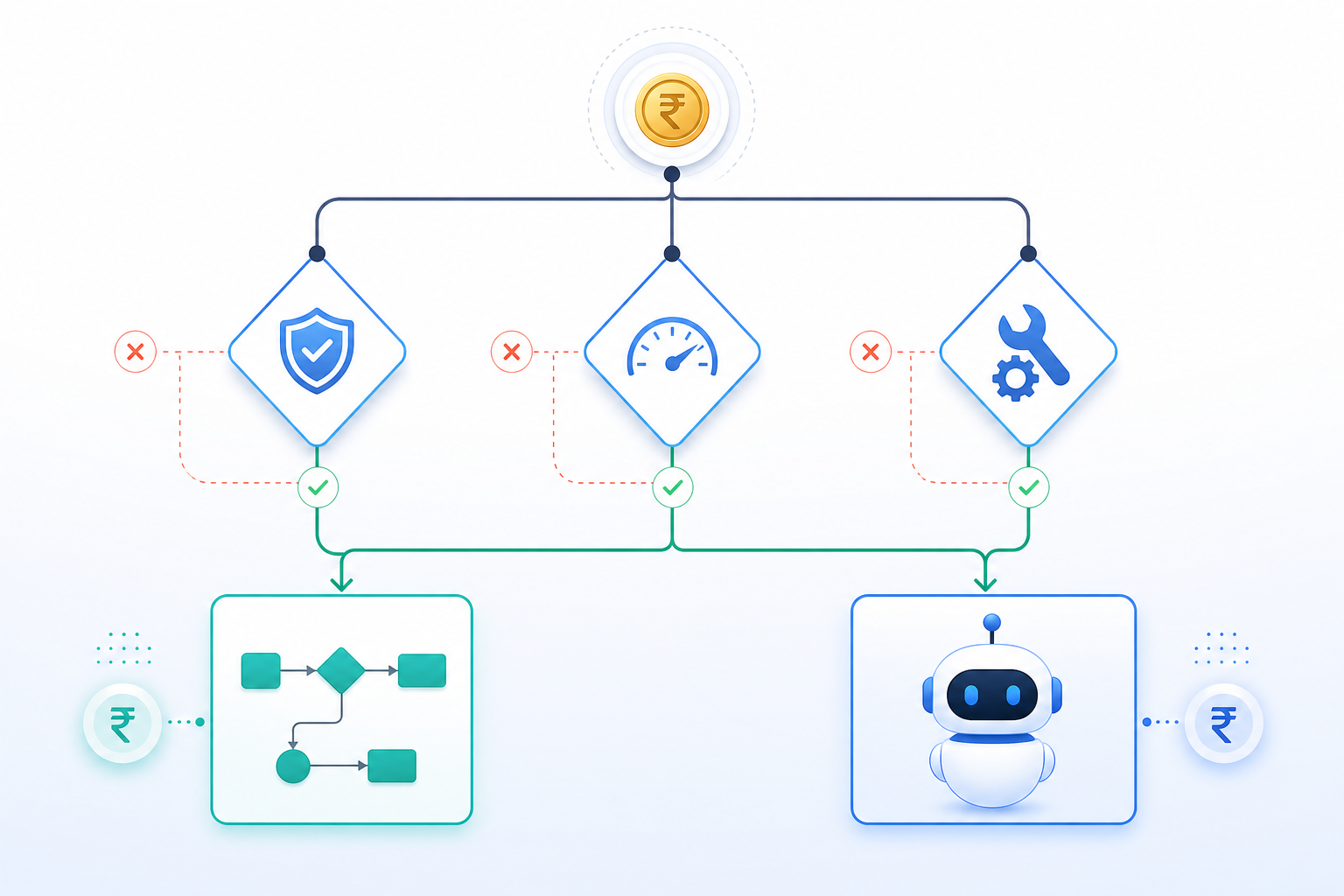
Definitions (founder‑level): what we mean by agent vs workflow
Workflow (deterministic): A sequence of known steps. Example: “When a WhatsApp lead arrives → validate fields → check CRM → create deal → send intro message → assign owner.” No improvisation. If you add an LLM at one step (e.g., normalize names or summarize a note), it’s still a workflow.
Agent (tool‑using, improvisational): A planner + executor that decides what to do next based on context, can call tools (email, browser, calendar, database), and learns from feedback. Useful when order is unknown or information is incomplete.
Agents are powerful. They’re also expensive to run, slow to debug, and fragile in the wild. Start with a workflow unless the problem demands improvisation.
The 3‑question test: do you need an agent at all?
Answer these in order. If you hit a “No” early, ship a workflow, not an agent.
Q1. Is the real‑world order unknown or changes week to week?
If your team already follows the same SOP every time, a workflow wins. Agents shine only when the next step depends on fresh, messy context (e.g., “Search this RFP, browse supplier sites, compare specs, draft a response”).
Q2. Is the cost of a wrong step low and reversible?
Agents make creative mistakes. If a wrong step can burn a lead, trigger a billing error, or violate compliance (DPDP) — don’t start with autonomy. Add human approval or stay deterministic.
Q3. Do you need tools that require reasoning to pick and use?
If you just need to call one known API with validated inputs, you don’t need an agent. If you need to choose between multiple tools (“search site vs open PDF vs query DB”), or chain them with judgment, an agent may be justified.
Cost and failure‑rate bands for India (2026)
Use these as planning guardrails, not quotes. Your volume, prompt design, and model routing will move the number up/down. When in doubt, pilot small.
Option | Best for | ₹/month (planning band) | Likely failures | Debug burden | Time to MVP |
|---|---|---|---|---|---|
Rule‑based workflow | Stable SOPs: lead routing, ticket triage, payouts, invoice sync | Under ₹25k | Data mismatches, brittle regex | Low | Days |
LLM‑assisted workflow | Classification, summarization, data cleaning in one step | ₹25k–₹1.5L | Edge‑case mislabels, prompt drift | Low–Medium | 1–3 weeks |
Tool‑using agent | Unknown order: research, RFP drafts, multi‑system ops | ₹1.5L–₹6L+ | Loops, hallucinated actions, tool misuse | High | 3–8 weeks |
Multi‑agent system | Complex, cross‑team workflows with negotiation | ₹3L–₹15L+ | Emergent failure, cost blow‑ups | Very High | 6–12+ weeks |
Two drivers swing costs more than anything else: (1) tokens spent per step and (2) the number of steps. Route cheap work to cheap models and keep agents from planning forever. If you haven’t built a routing layer yet, start here: LLM Model Routing Strategy: A Founder’s Guide to Cutting AI Costs by 30–85% in 2026.

The failure‑rate playbook: reduce risk before you scale
Most “agent failures” are avoidable in design. Use these five gates and you’ll ship faster with less drama.
Shadow mode first: Run the agent alongside humans for 2–4 weeks, log every decision, and compare to the SOP. No external actions allowed.
Human‑in‑the‑loop where it matters: Approval for irreversible steps: sending WhatsApp messages at scale, making payouts, updating contracts.
Hard constraints at the edge: Timeouts, max tool calls, max spend per run, allowlists for URLs/tools. If a run hits a wall, fail safe.
Deterministic wrappers: Let the agent decide what to do, but execute API calls through small, tested functions that validate inputs.
Fallbacks: If confidence is low or time runs out, route to a simpler workflow or a human queue — automatically.
Bonus: instrument everything (tokens, tool calls, latency, error types). Observability is your safety net and your cost lever.
The workflow‑first 90‑day rollout (what works for Indian teams)
Weeks 0–2: write the SOP, wire a basic workflow
Document the exact steps humans follow today (5–15 bullets). This is your spec.
Automate the happy path with a no‑brainer workflow (cron + queue, or a no‑code tool). Keep logs.
Weeks 3–4: add one LLM assist
Pick the single step that’s slow or fuzzy (classification, summary, data cleanup). Drop in an LLM call there only.
Add a confidence score and a threshold. Below threshold → human review.
Weeks 5–8: expand coverage and guardrails
Measure: cost per item, lead time, error rate. Kill prompts that drift.
Route cheap work to cheaper models; cache duplicate answers.
Weeks 9–12: trial an agent where order is unknown
Only now pilot an agent for the part with variable steps (e.g., “search + compare + draft”).
Ship it in shadow mode with hard budgets, and a clear fallback to the workflow.
ROI math you can run in 5 minutes (₹)
Use your numbers; this is a template.
Manual monthly cost = tasks/month × minutes/task ÷ 60 × fully‑loaded hourly cost.
Fully‑loaded hourly cost ≈ (monthly salary × overhead factor) ÷ 160. Many Indian teams use 1.2–1.4 as the overhead factor.Automation monthly cost = model spend + infra/orchestration + human oversight hours × hourly cost.
Payback = manual cost − automation cost. If payback ≥ 30% and quality is stable, scale. If not, simplify the solution (usually: remove the agent).
Illustration: If an ops process takes 5 minutes × 4,000 items/month = 20,000 minutes (~333 hours). At a fully‑loaded ₹75,000/month per FTE, ~₹469/hour. Manual ≈ ₹1.56L/month. An LLM‑assisted workflow with routing and light oversight might land well below that; a free‑roaming agent without guardrails will usually overshoot it. The design decides the bill.

India‑specific edges (don’t skip these)
DPDP compliance and consent: If you’re processing personal data, log purpose and consent, and prefer deterministic writes. For BFSI/health, consider data residency and on‑prem options before agents.
Multilingual inputs (English + Hindi + regional): Use a normalizer step early; keep prompts language‑agnostic; test with Hinglish to avoid silent drift.
WhatsApp reality: High‑volume outreach must be template‑approved and rate‑limited. Keep the “send” step behind approval until you’re sure. For channel math and BSP policy nuances, see your WhatsApp AI decisions — or ask us.
Procurement: Plan for INR billing, GST invoices, and RBI LRS constraints if you buy credits in USD.
Latency and cost bursts: Mobile networks + large models can spike timeouts. Timebox agent runs and cache aggressively.
When agents are the right call
Cross‑system research or reconciliation: Find, read, and compare data across websites, PDFs, and internal docs before taking an action.
Unstructured, case‑by‑case drafting: RFP replies, partner emails, policy memos where raw material changes daily.
Tool choice under uncertainty: Pick which tool to use based on fresh context (browse vs database vs spreadsheet).
Multi‑turn conversations with memory: Customer support that must track context across days and channels.
Operator bandwidth is the bottleneck: When the alternative is adding multiple headcount, a well‑guarded agent can pay back.
But know the tax: multi‑agent systems are powerful and pricey. If you’re flirting with that path, read this first: Multi‑Agent AI in 2026: Why It Costs 5–30x More — And the 3‑Question Test Before You Build One.
How to buy and price (quick founder guide)
Per‑seat works for internal tools your team “uses.” Simple, predictable, but mismatched when software replaces labor.
Usage‑based (per run, per 1K tokens) aligns with cost control. Watch for prompt bloat and retries.
Outcome‑based (per qualified lead, per ticket, per document) maps to value, but needs clear definitions and QA gates.
Hybrid (platform fee + usage or outcomes) is what most teams settle on after 60–90 days.
Whatever you pick, cap spend by default, and insist on a kill‑switch at the workflow level.
Tooling map (pick categories, not hype)
Workflows: A queue + workers + retries (serverless, or a scheduler like Airflow/Temporal). No‑code is fine to prove value; export to code later.
LLM layer: Prompt templates, evaluation harness, and routing between cheap and strong models. Start here if you haven’t: LLM Model Routing Strategy.
Guardrails: Input validation, allowlists, budget/time guards, and human approvals for irreversible writes.
Observability: Logs of prompts, tokens, tool calls; dashboards for cost, latency, and error classes.
Channels & tools: WhatsApp Business API, email, calendar, browser, DB clients — wrapped behind tested functions.
Your 5‑minute founder cheat sheet
Ask: Is order known? Is error low‑risk? Is tool choice trivial? If yes, ship a workflow — no agent.
Start tiny: One SOP → one workflow → one LLM assist. Route cheap work to cheap models.
Prove it: Shadow mode, approvals, hard budgets, fallbacks. Instrument everything.
Scale deliberately: Only add autonomy where humans decide today. Keep irreversible steps deterministic.
Review monthly: Kill prompts that drift. Compare manual vs automation cost and quality on a single page.
Where to go next
If your decision touches product scope and team design, read the Fractional CTO Operating Manual to see how we structure tech decision‑making for non‑technical founders. For cost control at the model layer, start with LLM Model Routing. If you still think you need multi‑agent orchestration, sanity‑check yourself with the multi‑agent cost framework.
If you want a second opinion on your stack — where a dumb workflow will beat a smart agent, and where real autonomy will pay back — book a free strategy call.
Frequently Asked Questions

Rishav Shankar
Rishav Shankar is a calm-tech architect who blends AI, engineering, and psychology to design systems that think before they act. He builds products that turn complex human problems into intuitive digital experiences, redefining how founders and teams operate. At the intersection of automation, strategy, and imagination, Rishav is creating the future one intelligent workflow at a time.
Comments
Loading...