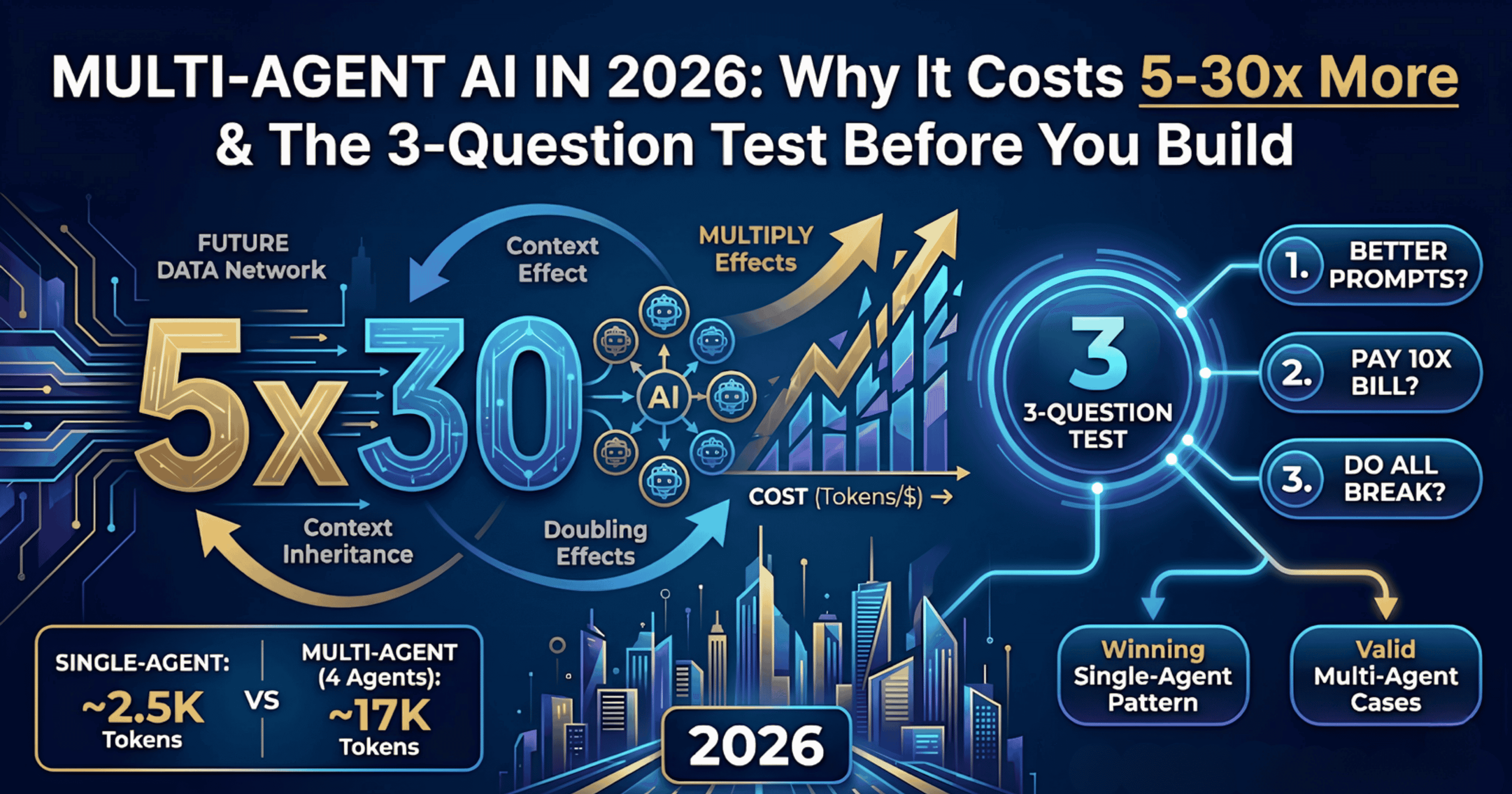
Recent production benchmarks reveal something most founders building AI agents don't expect: agentic AI systems consume 5-30x more tokens per task compared to standard chatbot interactions. In specific multi-step scenarios, a single task can balloon from 2,000 tokens to 120,000 — a 60x spike. The cost spread between a simple linear LLM call and a planning-heavy multi-agent system can reach 70x in real production deployments.
This isn't a hypothetical concern. It's the daily reality of production AI in 2026.
I work as a fractional CTO with founders building production AI systems. The most common architectural mistake I see in early-stage SaaS startups in 2026 is shipping multi-agent setups before they need them — and watching their AI bill explode 60-90 days after launch.
If you're building with CrewAI, LangGraph, AutoGen, the new Microsoft Agent Framework, or OpenAI's Agents SDK — you need to understand what you're committing to financially before you commit to it architecturally. Let's walk through the math, the framework landscape, and a decision framework you can apply this week.
The Real Token Math: Why Multi-Agent Costs Compound
Here's what most multi-agent tutorials don't tell you. Multi-step agent loops compound token costs at O(N²), not linearly. This is because LLM APIs bill for the entire conversation history on every call, and in a multi-agent system, every agent in the chain receives the full accumulated context.
Let's make this concrete with a 4-agent system handling a single user request:
Agent in chain | What it sees | Approx input tokens |
|---|---|---|
1. Router | User input only | 2,000 |
2. Researcher | User input + Router's decision | 3,000 |
3. Drafter | User input + Router + Research results | 5,000 |
4. Reviewer | All of the above + Draft response | 7,000 |
Total input | — | 17,000 tokens |
Compare that to a single agent handling the same request: roughly 2,500 tokens total. That's 6.8x more tokens for the same final output — and we haven't even counted the cost of output tokens, retry loops, or framework overhead yet.
Recent industry research from production benchmarks shows isolated subagent patterns use approximately 9K total tokens for multi-domain queries, while skills-based patterns that accumulate context can consume 15K tokens — a 67% increase just from context inheritance. A 20-step agent loop can consume over 10x the tokens a per-step estimate suggests.
The Four Hidden Cost Multipliers Nobody Tells You About
Beyond the raw token math, four structural forces push real-world multi-agent costs into the 5-30x range:
1. Context Window Inheritance
Each agent in the pipeline inherits all prior context. By agent 4, the conversation has tripled in size. This isn't a bug — it's how the architecture is designed to work. But it means each downstream agent pays for everything that came before it.
2. Output-as-Input Doubling
When agent 1's output becomes agent 2's input, you pay for those tokens twice — once as output, once as input. Across 3-4 agents, this doubling effect compounds quickly. A 500-token response generated by Agent 1 becomes 500 paid-for input tokens for Agents 2, 3, and 4.
3. Framework Orchestration Overhead
Framework wrappers (CrewAI, LangGraph, AutoGen, Microsoft Agent Framework, OpenAI Agents SDK) add their own tokens — system prompts, tool descriptions, agent role definitions, handoff metadata. Typically 500-1,500 extra tokens per agent invocation. These are tokens you pay for that don't appear in your business logic.
4. Retry and Self-Correction Loops
When agent 3 produces output that fails agent 4's review, the system retries. Sometimes 2-3 times. Each retry pays full cost. Some multi-agent systems in production have effective retry rates of 30%+ — meaning a third of requests cost 2x the baseline.
The 2026 Cost Reality: Why This Matters More Than Ever
Enterprise blended token costs have actually dropped 67% year-over-year — from $18.40 per million tokens in mid-2025 to $6.07 in April 2026. Enterprises that fully implemented optimized routing patterns (Tiered Intelligence Stack) achieved median costs of $2.31 per million tokens.
This sounds like good news — and it is, if you're architecting carefully. But it also means founders who skip the architecture work are paying premium prices for inefficient designs at exactly the moment when smart architecture is delivering 87% cost reductions.
Architecture pattern | Cost per million tokens (median) | vs Baseline |
|---|---|---|
Single-agent, single-model | $6.07 | 1.0x (baseline) |
Tiered Intelligence Stack (optimized routing) | $2.31 | 0.38x |
Naive multi-agent (no caching, no routing) | $18-30+ | 3-5x |
Worst-case planning-heavy agent loop | $60-180+ | 10-30x |
If you're sitting at the worst-case end of this table with 1,000 active users — that's the difference between a $6,000/month AI bill and a $180,000/month AI bill for the same product.
The 2026 Framework Landscape: What Actually Works in Production
Framework choice can swing benchmark performance by up to 30 percentage points on the same underlying model — which means your framework decision is nearly as important as your model decision. Here's how the major options compare as of mid-2026:
Framework | Best for | Overhead per agent | Production maturity |
|---|---|---|---|
LangGraph | Stateful workflows, audit trails, human-in-the-loop | Moderate (graph nodes add 800-1,200 tokens) | High — passed CrewAI in GitHub stars in early 2026 |
CrewAI | Fast prototyping, role-based multi-agent | Low (simple abstraction, <500 tokens overhead) | Medium — limited control at scale |
Microsoft Agent Framework (formerly AutoGen) | Enterprise Azure deployments, conversational agent teams | Moderate-high (Semantic Kernel layer adds tokens) | High — v1.0 GA April 2026 |
OpenAI Agents SDK | Handoff-based workflows, native OpenAI integration | Low-moderate | High — built-in tracing and guardrails |
Anthropic Claude Agent SDK | Safety-critical, reliability-first applications | Moderate (robust error handling adds overhead) | High — passed AutoGen in production deployments |
Google ADK | Multimodal agents, GCP-native, A2A interoperability | Moderate | Early — backed by Vertex AI, growing fast |
One important meta-point: every major framework now supports the Model Context Protocol (MCP) and Agent-to-Agent (A2A) standards — both of which moved to Linux Foundation stewardship in 2025. The framework lock-in problem of 2024 is largely solved. Choose for your workflow style, not for ecosystem prison.
When Multi-Agent IS Worth the Cost
I'm not anti-multi-agent. Microsoft's own production guidance is clear: start with single-agent architecture and only move to multi-agent when specific criteria mandate separation. Those criteria do exist. Here are the three patterns where multi-agent earns its cost:
1. Genuinely Heterogeneous Tasks Across Domains
If one workflow needs to query a database, another needs to call an external API, and another needs to compose text in radically different domains — different agents with different system prompts and tool sets make sense. The token cost is real but unavoidable. Real production example: a financial institution restructured its credit memo process using multi-agent architecture and achieved a 60% productivity gain for analysts (per McKinsey research).
2. Hard Privacy / Compliance Boundaries
When different parts of your workflow need different data permissions, multi-agent isn't an efficiency choice — it's compliance. Agent A sees customer data but not payment data. Agent B sees payment data but not browsing history. Common in healthcare, finance, and any regulated industry. A global bank in McKinsey's research cut IT modernization timelines by over 50% using multi-agent deployment specifically to manage organizational/data boundaries.
3. Latency Parallelization
If you can run multiple agents in parallel (not sequentially), you can reduce wall-clock time even though total token cost is higher. Useful when the user is waiting. Search engines, research tools, and clinical decision support systems often use this pattern: 5 agents query 5 sources simultaneously, then a reducer synthesizes.
If your use case doesn't match one of these three patterns — you probably don't need multi-agent. You need a better single agent.
The 3-Question Test Before You Ship Multi-Agent
Before you commit to a multi-agent architecture, run this test:
Question 1: Can a Single Agent With Better Prompts Do This?
90% of the multi-agent systems I see in production could be replaced by a single well-crafted prompt with structured output. If your agent 1's job is "decide which workflow to run" and agent 2's job is "execute that workflow," that's not two agents — that's a routing prompt.
The test: can you write the entire flow as a single system prompt with conditional logic? If yes, you don't need agents. You need a better prompt and structured output (JSON schema enforcement). Modern LLMs — Claude Sonnet 4.6, GPT-5, Gemini 2.5 Flash — support function calling and structured output natively. A single agent with 3-4 well-defined tools beats a 4-agent chain almost every time in cost and reliability.
Question 2: Will I Be Paying 10x My Projected AI Bill in 90 Days?
This is the gut-punch question. Most founders run a small pilot, see costs at $40/month, and scale up. Three months later, they're at $4,000/month and don't understand why.
Multi-agent costs scale faster than user count because the average conversation grows longer over time (users have more context, ask follow-up questions). In a multi-agent system, those tokens hit every agent in the chain.
If you can't model your AI costs at 10x current usage — you're not architecting, you're hoping.
Question 3: If One Agent Breaks, Do All of Them Break?
Single agents fail cleanly: bad output, retry, log it, move on. Multi-agent systems fail in cascading ways. Agent 1 hallucinates a category. Agent 2 looks up information for the wrong category. Agent 3 drafts a response that's contextually wrong. Agent 4 reviews against the wrong success criteria. Everything passes — and the user gets a confidently wrong answer.
Multi-agent failures are harder to debug because the error happens 3 steps back from where you see it. This is one of the strongest arguments for staying single-agent until you genuinely outgrow it.
What to Build Instead: The Single-Agent Pattern That Wins
For 80% of "I need a multi-agent system" cases, here's the cheaper, more reliable alternative. This is the pattern I implement most often as a fractional CTO for early-stage AI products:
Component | Implementation | Why it matters |
|---|---|---|
Single well-tuned agent | One LLM call per turn, with structured output enforcement | Predictable cost, easy debugging |
JSON schema output | Force the model to return structured fields downstream code handles | Eliminates "agent 2's parsing of agent 1's output" overhead |
Deterministic routing | Simple keyword/embedding checks for non-AI decisions | Save LLM tokens for actual generation work |
Tool calling (not agent chains) | One agent invokes multiple tools instead of passing context | Same context window, multiple actions |
Aggressive output caching | Cache identical inputs at the prompt level | 30-50% cost reduction in support-style workloads |
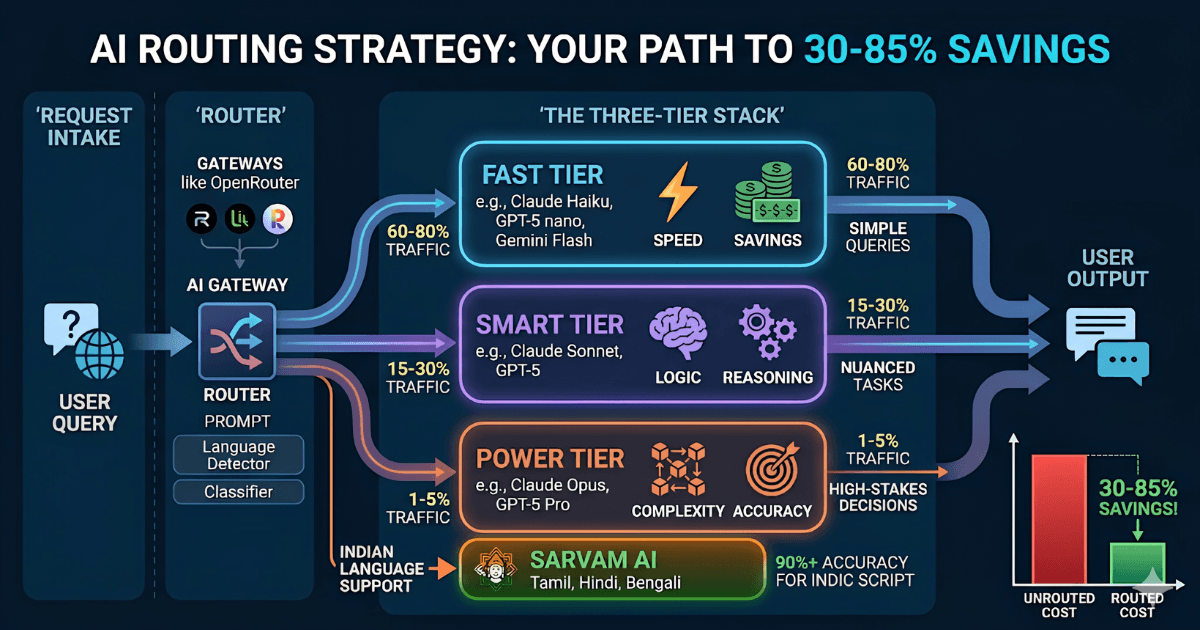
Model tiering | Haiku for simple tasks, Sonnet for hard ones, route based on complexity | Achieves $2.31/M token economics |
This pattern handles 80% of production use cases at 1/5 to 1/10 the cost of multi-agent architectures, with dramatically simpler debugging and observability.
Cost at Scale: What This Means for Your Business
Let's project the cost difference across user volumes for a typical conversational AI use case (20 requests/user/month, average 3K-token conversation):
Monthly active users | Single-agent (optimized) | Naive multi-agent | Difference |
|---|---|---|---|
100 | ~$15/mo | ~$75-225/mo | $60-210/mo |
1,000 | ~$150/mo | ~$750-2,250/mo | $600-2,100/mo |
10,000 | ~$1,500/mo | ~$7,500-22,500/mo | $6,000-21,000/mo |
100,000 | ~$15,000/mo | ~$75,000-225,000/mo | $60,000-210,000/mo |
At 10,000 users, the architectural choice between optimized single-agent and naive multi-agent is the difference between a $1,500/month AI bill and a $22,500/month AI bill. That's $250,000 per year in annual difference for the same product feature set.
This is why architecture is not a technical concern. It's a business model concern.
The Pattern That Holds Up Over Time
The architectural pattern that survives 18 months in production:
One well-tuned agent for the primary task
Structured outputs enforced via JSON schema
Deterministic routing for non-AI decisions
Tool calls for actions (database, APIs, calculations)
Aggressive caching at every layer
Model tiering for cost (cheap for simple, premium for hard)
Multi-agent only when one of the three valid use cases applies
Junior implementations chase the impressive architecture. Senior implementations chase reliability and unit economics. The boring answer wins more often than the impressive one.
Closing
If you're an early-stage founder mid-way through wiring up CrewAI, LangGraph, AutoGen, the Microsoft Agent Framework, or OpenAI's Agents SDK — pause. Run the three questions. Most of the time, you'll find a single well-built agent does the job at 1/5 the cost.
If you're working through this architectural decision and want a second opinion — fractional CTO work is something I do for founders building production AI systems. Reach out on LinkedIn or contact us via Rian Infotech.
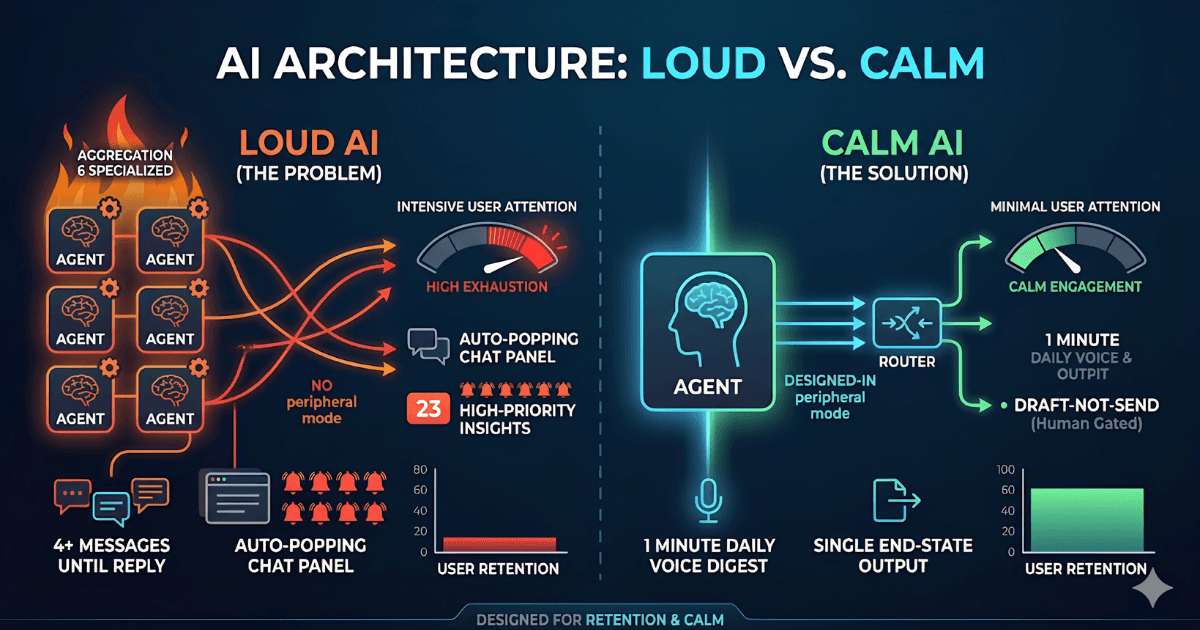
For deeper reading on related architecture decisions, see our upcoming posts on multi-model routing strategies and Calm-Tech AI architecture principles.
External references and further reading:
Frequently Asked Questions

Rishav Shankar
Rishav Shankar is a calm-tech architect who blends AI, engineering, and psychology to design systems that think before they act. He builds products that turn complex human problems into intuitive digital experiences, redefining how founders and teams operate. At the intersection of automation, strategy, and imagination, Rishav is creating the future one intelligent workflow at a time.
Comments
Loading...