Most Founders Hire a Fractional CTO and Then Waste 60% of Their Investment
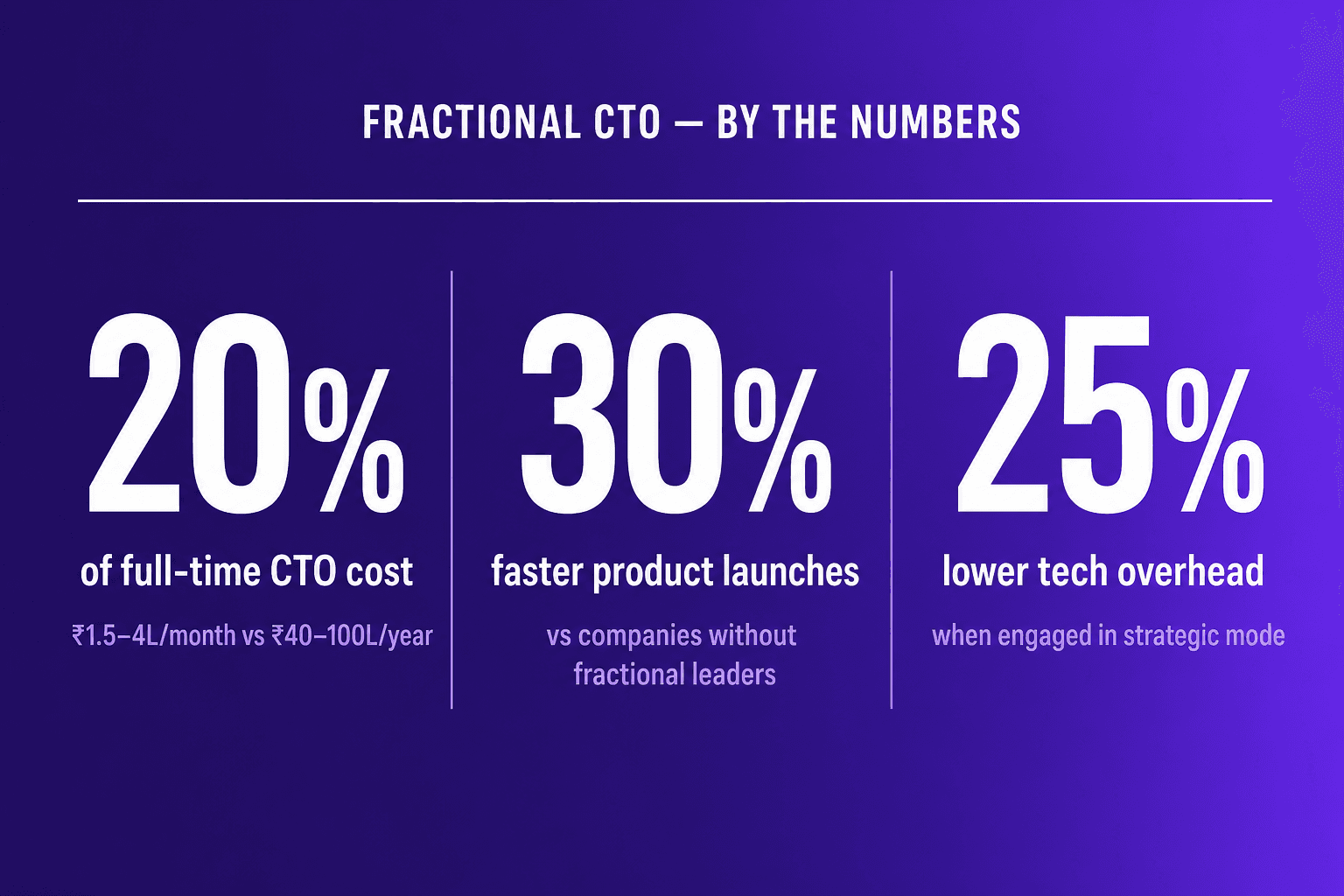
Here's a number that should give you pause: a full-time CTO in India now commands ₹40–100 lakh per year in cash compensation, with senior brackets crossing ₹1.5 crore when you add ESOPs. A Fractional CTO engagement, by contrast, runs ₹1.5–4 lakh per month — roughly 20% of the full-time cost for the same calibre of strategic thinking.
That math is compelling. Which is why hundreds of Indian seed-to-Series-A founders made the call in the last two years — the share of Indian startups engaging fractional leaders jumped 25% year-over-year in 2024, and the trend has only accelerated into 2026.
But here's the problem nobody talks about: most of those founders are getting a fraction of the value they paid for. Not because their Fractional CTO is bad. Because they're using them wrong.
They assign them sprint tickets. They loop them in on Slack channels they don't need to be in. They book them for status calls instead of architecture reviews. They treat a strategic C-suite partner like a senior contractor — and then wonder why the engagement feels flat six months in.
This is the operating manual that fixes that. Whether you're about to sign your first Fractional CTO contract or you're two months in and feeling underwhelmed, these are the frameworks, cadences, and delegation decisions that separate the founders who get 10x from those who get 1x.
The Single Biggest Mistake: Confusing a Fractional CTO with a Senior Developer
A senior developer ships code. A CTO decides which code should exist.
That distinction sounds obvious, but it collapses in practice for most early-stage teams. When your engineering team is small — three to eight people — every senior person gets pulled into implementation. The Fractional CTO starts reviewing PRs, debugging deployment pipelines, and unblocking tickets. Three months later, you've spent ₹10 lakh on the world's most expensive senior engineer.
The correct mental model: your Fractional CTO is the translator between your business goals and your technical execution. Their highest-value hours are the ones spent on decisions that will shape the next 12–18 months of your product — not the next sprint.
A 2024 study of mid-stage Indian startups found that companies that engaged a Fractional CTO in a purely strategic role trimmed product launch timelines by 30% and cut tech overhead by 25% compared to companies where the fractional leader was blended into implementation. The leverage is in the thinking, not the doing.
The Five High-Leverage Activities to Always Delegate to Your Fractional CTO
1. Technology Architecture Decisions
Every architectural choice you make in year one — your database, your cloud provider, your microservices vs. monolith call, your AI infrastructure — compounds over the next three years. A wrong call here doesn't cost you a sprint; it costs you a rewrite at the worst possible time (usually when you're scaling after a funding round).
Your Fractional CTO should own every significant architectural decision with a lifespan of more than six months. That means: system design documents, vendor evaluation frameworks, API structure, data modelling strategy, and your AI/ML infrastructure choices. In 2026, this specifically includes decisions around LLM deployment (cloud vs. private), RAG pipeline architecture, and which AI capabilities to build versus buy.
2. Engineering Hiring and Team Structure
Finding a CTO-calibre full-time hire takes 120–180 days in India's current market. Finding good senior engineers takes 60–90 days. These timelines are brutal for a startup moving fast — and the cost of a bad hire at the senior engineering level is typically 3–6x the annual salary in lost productivity, severance, and re-hiring costs.
Your Fractional CTO should define the hiring bar, write or review every technical JD, conduct or structure the technical interview stage, and make the final call on senior engineering offers. A good Fractional CTO will often save their entire annual fee in a single avoided mis-hire.
3. Build vs. Buy Decisions
Every quarter, your product team will generate a list of capabilities they want. Some should be built. Many should be bought. A few should be neither — scope creep dressed up as product vision.
The build-vs-buy decision is deceptively hard. It requires understanding your team's actual velocity (not their estimate of it), the total cost of ownership of vendor integrations, the lock-in risk of third-party dependencies, and the strategic value of owning the capability yourself. In 2026, this has become the top reason early-stage companies engage fractional CTOs — specifically for AI capability decisions where the vendor landscape is changing every 90 days.
4. Technical Due Diligence (Both Directions)
If you're raising a round, acqui-hiring a small team, or negotiating a significant technology partnership, your Fractional CTO should lead the technical due diligence on your side. This includes preparing your tech stack for investor scrutiny, documenting your architecture, quantifying your technical debt honestly, and presenting your engineering velocity credibly.
Investors increasingly conduct their own deep technical due diligence at Series A and beyond. Having a credible, senior technical voice who can answer those questions — rather than a founder approximating answers — meaningfully improves how your startup is perceived.
5. AI Strategy and Roadmap
In 2026, every Indian startup is under pressure to have an AI story. The problem is that most founders don't know which AI capabilities are genuinely useful versus well-marketed, which are worth building versus buying, and which are a distraction from the core product.
Your Fractional CTO should own your AI strategy: evaluating which tools are worth integrating, building a framework for responsible adoption, choosing between models (GPT-4o, Claude, Gemini, Sarvam for Indian language contexts), and translating your AI vision into an engineering roadmap the board can act on. This is one of the highest-leverage areas in 2026 — and one of the most expensive to get wrong.
The Engagement Structure That Actually Works
The most common engagement model in the Indian market is a monthly retainer of ₹1.5–4 lakh for one to two days per week. But the number of days matters less than how those days are structured. Here's the cadence that consistently generates the best outcomes:
Cadence | Activity | Duration |
|---|---|---|
Weekly | Async update from engineering lead + Fractional CTO response | 30 min async |
Bi-weekly | Architecture or decision review call with founder + tech lead | 60–90 min |
Monthly | Strategic roadmap review — priorities, risks, hiring, tech debt | 2–3 hours |
Quarterly | Deep-dive: team structure, tech stack audit, investor prep | Half day |
On-demand | Escalations: major vendor decisions, key hires, incident post-mortems | As needed |
The critical rule: your Fractional CTO should never be your team's first line of escalation. That role belongs to your tech lead or engineering manager. The Fractional CTO is the escalation point for your tech lead — and the strategic advisor for you, the founder. Conflating these roles is how you burn expensive hours on Slack noise.
How to Know It's Actually Working: The Three-Month Check
A good Fractional CTO engagement should pay for itself within 90 days. Not in revenue — in avoided costs, better decisions, and improved team velocity. Here's how to measure it:
Decision Quality
Are the architectural and hiring decisions from the past 90 days holding up? Or are you already revisiting choices made in month one? A good Fractional CTO makes decisions that scale — you shouldn't be re-architecting the same components every quarter.
Engineering Velocity
Is your team shipping faster, or is the Fractional CTO creating a dependency bottleneck? If engineers are waiting for approval on every decision, the engagement is too hands-on. If velocity has increased without quality regression, the engagement is calibrated correctly.
The "Could We Do This Without Them?" Test
After 90 days, ask yourself: could your tech lead or senior engineer make the decisions the Fractional CTO is making? If yes, you either have a very strong tech lead (great — consider promoting them) or the Fractional CTO is operating too low. If no — if there are genuinely decisions being made that nobody else on your team could make — the engagement is delivering real value.
Founder Confidence
Are you, as the founder, more confident walking into investor meetings, partnership conversations, and product planning sessions? Do you have a clearer view of your technical risks, your team's capabilities, and your 12-month roadmap? If yes, the Fractional CTO is doing their most important job: giving you strategic clarity you didn't have before.
Real Examples: What Good Looks Like
The Healthtech Startup That Avoided a ₹80 Lakh Rewrite
A Mumbai-based healthtech startup had spent six months building a microservices architecture on Kubernetes — following best practices they'd read about, not ones that matched their scale. Their engineering team of four was spending 40% of their time on infrastructure instead of product. A Fractional CTO, engaged for two days a month, identified the mismatch in week one: they needed a well-structured monolith, not a distributed system. The migration took three weeks. Engineering velocity doubled. The avoided cost of continuing down the wrong path: an estimated ₹60–80 lakh in wasted engineering time over 18 months.
The B2B SaaS Startup That Closed a Series A Faster
A Bengaluru SaaS startup preparing for a Series A had a technical co-founder who was deeply capable but had never been through an investor due diligence process. Their Fractional CTO spent one day preparing the technical data room — architecture documentation, security posture, engineering velocity metrics, tech debt quantification — and was available for the investor's technical Q&A call. The founder reported that technical due diligence, which had stalled a previous raise, was cleared in a single session. The round closed six weeks faster than anticipated.
When to Stop: The Signals That You've Outgrown the Fractional Model
The Fractional CTO model has a natural expiry date. Here are the signals that you've reached it:
Your engineering team exceeds 8–10 people and leadership is becoming a full-time coordination job, not a strategic one
Your core product is software and you need someone with equity-level commitment to the long-term technical vision
You're post-Series A and investors expect a named CTO on your leadership page
Your Fractional CTO is regularly available less than they need to be — engagement is feeling thin relative to your pace of decision-making
You're entering a regulated domain (fintech, healthtech, edtech) where full-time technical accountability is a compliance requirement
The right approach: use your Fractional CTO to hire their own replacement. A good Fractional CTO will write the full-time CTO job description, conduct the technical interviews, and help you evaluate candidates — then transition the incoming CTO with full context on every decision made during the engagement. This is the cleanest, most valuable exit from the fractional model.
The Bottom Line for Indian Founders in 2026
The Fractional CTO model works. The data is clear: when used correctly, it trims product launch timelines by 30%, cuts tech overhead by 25%, and delivers C-level strategic thinking at 20% of the full-time cost. In a market where a full-time CTO search takes 120–180 days and often ends in a mis-hire, the fractional model is one of the highest-leverage decisions an early-stage founder can make.
But the model only works if you treat it correctly. The founders who get 10x from their Fractional CTO engagement are the ones who protect their fractional leader's time for strategic decisions, build a clean escalation structure that keeps implementation noise away from the strategic layer, run structured monthly and quarterly reviews, and measure outcomes in decisions and velocity — not hours logged.
The founders who get 1x are the ones who hand over a Jira board and wonder why nothing changed.
You now know which group to be in.
Ready to implement this for your business? At Rian Infotech, we provide Fractional CTO services built specifically for Indian startups navigating the AI era — from architecture decisions and team building to fundraise preparation and AI strategy. Contact Rian Infotech to discuss what the right engagement model looks like for your stage and goals.
Frequently Asked Questions

Rishav Shankar
Rishav Shankar is a calm-tech architect who blends AI, engineering, and psychology to design systems that think before they act. He builds products that turn complex human problems into intuitive digital experiences, redefining how founders and teams operate. At the intersection of automation, strategy, and imagination, Rishav is creating the future one intelligent workflow at a time.
Comments
Loading...