Introduction: The Developer's Edge in a Fast-Moving AI Ecosystem
In the AI ecosystem, the line between an experimental notebook and a production-ready system is defined by the tools you master. Keeping up isn't about chasing hype; it's about identifying the architectural shifts that give you a competitive edge. For developers building sophisticated agents, robust automation pipelines, and next-generation AI-powered systems, continuously tracking new frameworks and agentic patterns is the critical discipline that separates functional prototypes from production-grade applications.
1. Today’s New AI Tools and Frameworks
This section breaks down the most significant libraries released in the last 24 hours. We'll cut through the noise to focus on their immediate, practical value for developers in the trenches, highlighting what’s new, why it matters, and how you can start using it today.
1.1 Transformers v5.0.0rc0
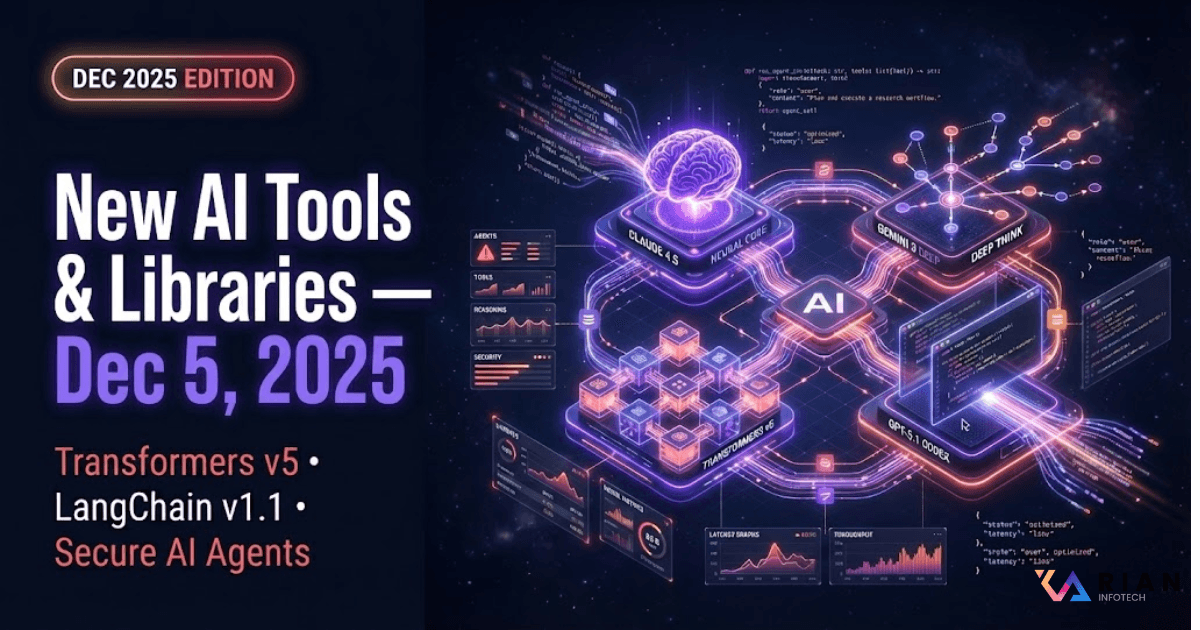
Transformers v5 is the library's first major release in five years, representing a complete rewrite from the ground up. This landmark version prioritizes modularity, native multimodal capabilities for text, video, and audio, and production-ready inference through seamless integration with high-performance stacks like vLLM, SGLang, and ONNX. The ecosystem has seen massive growth, now supporting over 750,000 Hub checkpoints, up from just 1,000 at the time of v4.
- Impact on Developers:
- Consolidated RAG Infrastructure: It consolidates the infrastructure needed for building and serving complex Retrieval-Augmented Generation (RAG) pipelines, simplifying the stack required for production.
- Production-Grade Reliability: Architected for the entire machine learning lifecycle—from training to serving—it delivers enhanced stability and performance through optimized inference engines, specialized kernels, and a focus on dtype standardization.
- Standardized Workflows: Deep interoperability across backends like llama.cpp and MLX allows you to standardize your workflows on a single, powerful library, regardless of the deployment target.
- Installation:
- Minimal Usage:
1.2 LangChain v1.1.0
LangChain v1.1.0 is a significant update focused on making agent development more reliable, structured, and efficient. The release delivers critical improvements in memory management, context handling, and API call speed, providing the stability needed to build production-grade agentic systems.
- Impact on Developers:
- Enables Advanced Agentic Architectures: The focus on production-grade reliability provides the stable foundation needed to implement emerging, externally validated patterns like the "planner, worker, refiner" model [1], moving beyond less reliable model self-correction approaches [3].
- Supports Reliable, Multi-Step Workflows: Improved memory handling and faster response times allow you to build agents that use external validation loops and structured playbooks [2, 3], a critical step up from simple chain-of-thought prototypes.
- Reduces Development Friction: An expanded ecosystem of integrations with the latest models reduces the setup time and boilerplate code required to build multi-LLM applications, letting you focus on core agent logic.
- Installation:
- Minimal Usage:
1.3 llm-agent-protector v0.1.0
llm-agent-protector v0.1.0 is a specialized Python package designed to secure LLM agents against prompt injection attacks and detect unintentional prompt leakage. It achieves this by using a polymorphic prompt assembler to enforce clear boundaries between system instructions and user inputs, coupled with canary-based detection to validate model responses.
- Impact on Developers:
- Addresses a Critical Security Vulnerability: For any agent that interacts with untrusted user input, prompt injection is a major security risk. This library provides a ready-to-use defense mechanism.
- Protects Sensitive Data: The canary-based leakage detection is essential for securing agents that handle proprietary or sensitive information, ensuring the model doesn't inadvertently expose parts of its system prompt.
- Easy Integration: The tool is designed for minimal code changes, allowing you to add a crucial security layer to production agents without a significant refactoring effort.
- Installation:
- Minimal Usage:
These releases are not isolated events; they are evidence of foundational shifts in how production AI systems are being built.
2. Why These Tools Matter Today: Key Developer Trends
Looking beyond individual releases to identify emerging patterns helps developers anticipate architectural shifts and make smarter, more forward-looking technology choices. Today's updates point to a clear maturation of the AI engineering discipline.
1. A Focus on Production-Grade Reliability and Security The industry is rapidly moving past the experimental phase and into an era of building robust, secure, and reliable AI systems. Releases like LangChain 1.1, with its emphasis on "production-grade agent reliability," and the security-first design of llm-agent-protector are clear indicators of this shift. This trend is further validated by new research into agentic Site Reliability Engineering (SRE) workflows [2] and long-horizon planning, which both stress the need for external validation loops and guardrails over pure model self-correction [3].
2. The Rise of Advanced Agentic Architectures Development patterns are evolving from single, monolithic agents to structured, multi-agent systems designed for complex problem-solving. Vellum's new guide on agentic workflows explicitly defines architectural patterns like "planner, execution, refinement" roles [1]. This is echoed in analyses of enterprise frameworks [4] and a new arXiv paper on multi-agent collaboration, which highlights the effectiveness of routing tasks between specialized agents to improve success rates and reduce latency [5].
3. Deepening Ecosystem Integration and Interoperability Frameworks are increasingly acting as central hubs that unify a fragmented ecosystem of models and tools. Transformers v5 is the prime example of this trend. Its complete rewrite was designed for "seamless integration" and "deep interoperability" with a vast array of inference backends, including vLLM, ONNX, and llama.cpp. This allows developers to build on a standardized foundation while retaining the flexibility to choose the best-performing tools for each part of their stack.
Understanding these trends is the first step; the next is applying them to solve real-world development challenges.
3. Best Use Cases for Developers
This section translates today's new tools and emerging trends into concrete, actionable use cases for developers.
- High-Performance RAG Pipeline Development For developers building production-grade Retrieval-Augmented Generation systems, Transformers v5 is the ideal foundation. Adopting it means you can build more robust systems while reducing technical debt and infrastructure complexity from day one.
- Orchestrating Complex, Multi-Step Agents This is where you move beyond single-prompt chains. Use LangChain v1.1's stability to implement stateful, multi-agent systems that follow advanced patterns like the "planner, worker, refiner" model [1] to handle complex, long-running tasks more effectively.
- Securing Customer-Facing AI Agents This is the primary use case for llm-agent-protector. It provides an essential security layer for any agent that processes untrusted user input, defending against prompt injection and data leakage attacks that could compromise application integrity.
While each tool addresses a critical need, the architectural overhaul in Transformers v5 merits a deeper analysis for its long-term impact on the entire AI stack.
4. Tool of the Day: A Deeper Look at Transformers v5
We've selected Transformers v5 as the "Tool of the Day" because it's not just an update; it's a landmark release that represents a paradigm shift. Described as the first major release in five years and a "complete rewrite," its launch signals a new level of maturity and standardization for the open-source AI community.
- Architectural Significance This release positions Transformers v5 as a stable abstraction layer, allowing development teams to decouple their application logic from the underlying inference engine. This reduces vendor lock-in and enables them to swap backends (e.g., from vLLM to ONNX) to optimize for cost or performance without a major refactor. The shift to modular model definitions and deep interoperability makes it the true central library for the full ML lifecycle.
- When Should You Adopt It? Companies should prioritize adopting Transformers v5 when:
- Building new multimodal applications that need to process text, video, or audio.
- Seeking to standardize their AI stack on a single, production-grade library to improve reliability and maintainability.
- Needing to consolidate and simplify the infrastructure for complex RAG pipelines.
- Getting Started Example
This foundational release paves the way for the next wave of AI development.
Closing Insights
Today's releases across frameworks, security tooling, and agentic research send a clear message: the era of AI prototyping is giving way to a focus on production engineering. Developers are now empowered with tools that enable them to build more sophisticated, reliable, and secure AI-powered applications with greater efficiency and architectural stability than ever before.

Rishav Shankar
Rishav Shankar is a calm-tech architect who blends AI, engineering, and psychology to design systems that think before they act. He builds products that turn complex human problems into intuitive digital experiences, redefining how founders and teams operate. At the intersection of automation, strategy, and imagination, Rishav is creating the future one intelligent workflow at a time.
Comments
Loading...