The tools released daily are no longer just incremental updates; they are foundational building blocks for solving core problems like long-term memory, complex task automation, and advanced model reasoning. Staying current is not just about adopting new features, but about understanding the architectural shifts that make a new generation of AI possible. This post will break down today's most impactful releases for the modern AI developer.
1. Today’s New AI Tools
This section provides a technical yet accessible overview of the most significant new Python libraries and frameworks that have emerged in the last 24 hours. The focus is on their direct, practical applications for developers looking to build more capable and resilient AI systems.
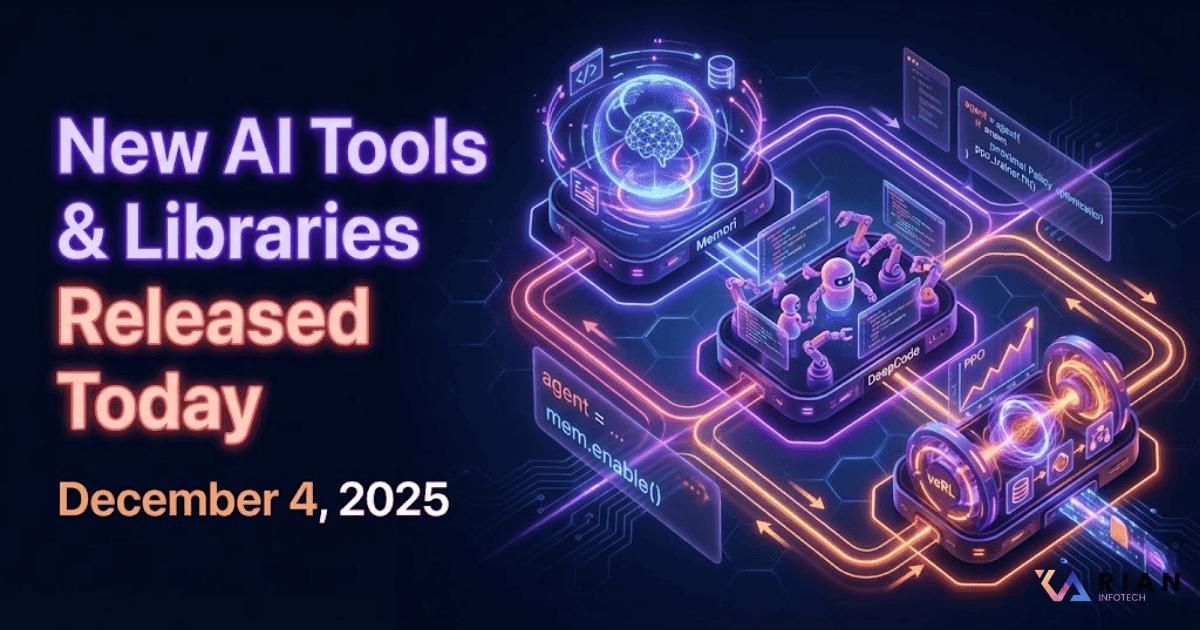
1.1 Memori (v0.1.0): A Stateful Memory Fabric for AI Agents
Memori is an open-source memory engine designed to provide long-term, stateful memory for AI agents. It integrates directly with serverless databases like MySQL or PostgreSQL to automatically ingest, track, and recall conversation history across different user sessions.
How it Helps Developers:
Solves Long-Term Persistence: Memori addresses the common "context window amnesia" problem, where agents forget past interactions, ensuring continuity and a more natural user experience.
Provides a Managed Memory Fabric: Instead of manually managing vector stores or databases, developers can "drop in" Memori to handle memory persistence automatically, abstracting away the underlying complexity.
Enables Personalization: By remembering user preferences and the history of tasks, agents powered by Memori can deliver highly personalized and context-aware responses without complex custom code.
Installation:
pip install memorisdk mysql-connector-python
Minimal Usage:
from memori import Memori
from openai import OpenAI

client = OpenAI(api_key="your-api-key")

# Initialize Memori with a database connection (e.g., GibsonAI or local MySQL)
# auto_ingest=True automatically captures and indexes the conversation
mem = Memori(
    database_connect="mysql+mysqlconnector://user:pass@host/db_name",
    conscious_ingest=True,
    auto_ingest=True
)

mem.enable() # Hooks into the client to inject relevant context

# The agent now "remembers" previous interactions automatically
response = client.chat.completions.create(
    model="gpt-4o",
    messages=[{"role": "user", "content": "Where did we leave off with the project?"}]
)

print(response.choices[0].message.content)
1.2 DeepCode (v1.2.0): An Agentic Coding Platform for Autonomous Engineering
DeepCode is a multi-agent platform for autonomous software engineering that orchestrates a team of specialized agents (e.g., Architect, Coder, Reviewer) to perform complex tasks. Its flagship features include "Paper2Code," which implements algorithms directly from research papers, and "Text2Web," which generates full web applications from descriptive prompts.
How it Helps Developers:
Moves Beyond Copilots: Unlike code completion tools, DeepCode functions as an autonomous engineering team, capable of managing an entire development pipeline from requirement to implementation.
Accelerates Research to Production: It is especially valuable for researchers and data scientists who need to rapidly prototype and validate complex algorithms from academic literature without getting bogged down in boilerplate code.
Automates Full-Stack Tasks: With features like Text2Web, it can handle end-to-end application generation, significantly reducing the manual effort required for building prototypes.
Installation:
pip install deepcode-hku
Minimal Usage:
import os
from deepcode.cli import main_cli

# DeepCode requires a local config file for agent orchestration.
# Download the default config if not present
if not os.path.exists("mcp_agent.config.yaml"):
    os.system("curl -O https://raw.githubusercontent.com/HKUDS/DeepCode/main/mcp_agent.config.yaml")

# Set your API key
os.environ["OPENAI_API_KEY"] = "sk-..."

# Programmatically trigger the 'Paper2Code' pipeline on a local PDF
# This orchestrates agents to read the paper and generate a Python implementation
print("Starting Paper2Code agent swarm...")
main_cli.run(
    task_type="paper2code",
    input_file="./attention_is_all_you_need.pdf",
    output_dir="./implementation"
)
1.3 veRL (v0.1.0-rc): High-Performance Reinforcement Learning for LLMs
veRL is a high-performance Python library for applying reinforcement learning techniques to large language models. It is specifically optimized for efficient Proximal Policy Optimization (PPO) and GRPO, supporting hybrid training backends that combine frameworks like FSDP or Megatron-LM for training with vLLM for fast generation.
How it Helps Developers:
Provides Industrial-Grade RL Infrastructure: As developers move beyond simple Supervised Fine-Tuning (SFT), veRL provides the robust, high-performance infrastructure needed to implement complex RLHF loops on consumer or cluster-grade GPUs.
Enables Advanced Reasoning Models: It bridges the gap for teams looking to build sophisticated "Reasoning Models" by providing the tools to fine-tune models for tasks that require complex, multi-step thought processes.
Optimizes Training Efficiency: Its support for hybrid backends allows developers to leverage the best tools for each part of the RL process—training and rollout—making the entire workflow more efficient.
Installation:
pip install verl
Minimal Usage:
import verl
from verl.trainer import RayPPOTrainer
from verl.utils import Config

# Define a minimal configuration for PPO training
# In practice, this config is loaded from a YAML file
config = Config(
    actor_model="Qwen/Qwen2.5-3B",
    train_batch_size=16,
    ppo_epochs=4,
    entropy_coeff=0.01
)

# Initialize the PPO Trainer with Ray backend for distributed rollouts
trainer = RayPPOTrainer(
    config=config,
    experiment_name="my_rlhf_agent",
    local_dir="./checkpoints"
)

# Start the training loop (Rollout -> Evaluate -> Update)
trainer.init_workers()
trainer.fit()
These individual tools are powerful on their own, but they also point toward broader, significant trends in AI engineering.
2. Why These Tools Matter Today: 3 Emerging Trends
Analyzing new tool releases reveals the direction of the industry and where the biggest challenges—and opportunities—lie. Today's releases highlight three major trends that signal a fundamental shift in how developers will build the next generation of AI applications.
Agentic Memory Becomes a Managed Service Tools like Memori signal a move away from manual, ad-hoc memory solutions like simple vector stores. The industry is shifting toward managed, stateful memory fabrics that are easy to integrate and solve the "context window amnesia" problem more systemically. This trend abstracts away database management and treats long-term memory as a core, pluggable component of the AI stack.
From Copilots to Autonomous Coding Swarms Systems like DeepCode represent the next evolution of AI-assisted development. The focus is moving beyond simple code completion (copilots) to autonomous, multi-agent teams that can handle entire engineering pipelines. This trend enables "one-shot" execution of complex tasks, such as implementing a complete algorithm directly from a research paper, fundamentally changing prototyping and research workflows.
The Democratization of Advanced RL Training Libraries like veRL are making complex techniques like RLHF and PPO accessible to a broader range of developers. Previously, fine-tuning models for sophisticated reasoning was the domain of large, specialized research labs. This trend provides the industrial-grade infrastructure needed for smaller teams and individual developers to build and customize models for niche tasks that require advanced reasoning capabilities.
Understanding these trends is key to identifying the concrete use cases where developers can gain the most leverage from new technology.
3. Best Use Cases for Developers
Knowing about new tools and trends is only valuable when applied to real-world problems. This section outlines concrete scenarios where today's new tools can deliver immediate and significant value to developers.
Building Stateful, Personalized Agents For creating a customer service bot, personal assistant, or any application that benefits from remembering past interactions, Memori is the key enabler. It provides the long-term memory needed for the agent to recall user preferences, conversation history, and previously completed tasks, leading to a more coherent and personalized user experience.
Automating Research-to-Production Pipelines A data scientist or ML researcher who needs to rapidly test an algorithm from a new academic paper can use DeepCode's "Paper2Code" feature to automate the entire process. This dramatically shortens the cycle from theoretical concept to working implementation, allowing for faster experimentation and validation.
Fine-tuning Models for Niche Reasoning Tasks To take an open-source model and improve its performance on a specialized task, such as financial analysis, legal document summarization, or medical text interpretation, veRL is the ideal tool. It provides the necessary RLHF/PPO infrastructure to fine-tune the model's reasoning capabilities far beyond what standard supervised fine-tuning can achieve.
Orchestrating Complex, Multi-Step Agentic Workflows For building a reliable agent that must call multiple tools in sequence, the "Orchestrator + Tool-Repair Guard" pattern is a modern best practice. An orchestrator agent decides which tools to call, while a separate "guard" validates inputs, retries failed calls with small corrections, and handles errors gracefully. This pattern, implemented alongside the new tools, creates more robust and resilient agentic systems.
While all these tools are impactful, one stands out for its foundational importance in building more human-like AI agents.
4. Tool of the Day: Memori, the Memory Fabric for Agents
While all the featured tools are valuable, Memori warrants a deeper look because it addresses a universal and critical challenge: long-term memory persistence. This is a foundational problem that nearly every developer building an agentic application will eventually face.
The core problem Memori solves is "context window amnesia." Without persistent memory, an agent forgets everything from a previous session the moment a new one begins. This leads to frustratingly repetitive conversations and an inability to build on past knowledge, forcing users to restate their needs and preferences endlessly.
Memori's architectural approach is to provide a "managed memory fabric." It hooks into existing LLM clients (like OpenAI's) and automatically ingests conversation history into a connected serverless database (MySQL or PostgreSQL). For developers, this provides a drop-in solution that abstracts away all the complexities of database schema design, data ingestion, and context retrieval, making stateful agents accessible without deep database expertise.
from memori import Memori
from openai import OpenAI

# 1. Standard OpenAI client setup
client = OpenAI(api_key="your-api-key")

# 2. Initialize Memori with a database connection string.
#    'auto_ingest=True' tells Memori to automatically capture
#    and index all conversations passing through the client.
mem = Memori(
    database_connect="mysql+mysqlconnector://user:pass@host/db_name",
    conscious_ingest=True,
    auto_ingest=True
)

# 3. Enable the memory hook. This patches the OpenAI client to
#    automatically inject relevant context from past conversations
#    into new prompts before they are sent to the model.
mem.enable()

# 4. Make a standard API call. Memori works in the background
#    to retrieve relevant memories and add them to the context,
#    making the agent stateful without changing the developer's workflow.
response = client.chat.completions.create(
    model="gpt-4o",
    messages=[{"role": "user", "content": "Where did we leave off with the project?"}]
)

print(response.choices[0].message.content)
When Should You Adopt Memori?
When building applications that require a high degree of personalization based on user history.
For agents that are designed to perform long-running, multi-session tasks that require continuity.
In any system where remembering user history, preferences, and past outcomes is crucial for the core user experience.
Memori, along with the day's other releases, points to a clear future for AI development where stateful, specialized agents become the norm.
Closing Insights
Today's releases highlight a clear trajectory in AI development. The tools and trends discussed—from managed memory with Memori, to autonomous coding with DeepCode, to advanced model training with veRL—are fundamentally changing developer workflows. We are moving from simply calling stateless APIs to architecting truly intelligent systems.
These tools empower developers to build more capable and robust AI applications faster than ever before. More importantly, they signal an architectural shift towards more stateful, resilient, and specialized AI agents. This evolution marks the next major step in the journey from basic API calls to the creation of autonomous, persistent, and genuinely helpful AI partners.

Rishav Shankar
Rishav Shankar is a calm-tech architect who blends AI, engineering, and psychology to design systems that think before they act. He builds products that turn complex human problems into intuitive digital experiences, redefining how founders and teams operate. At the intersection of automation, strategy, and imagination, Rishav is creating the future one intelligent workflow at a time.
Comments
Loading...