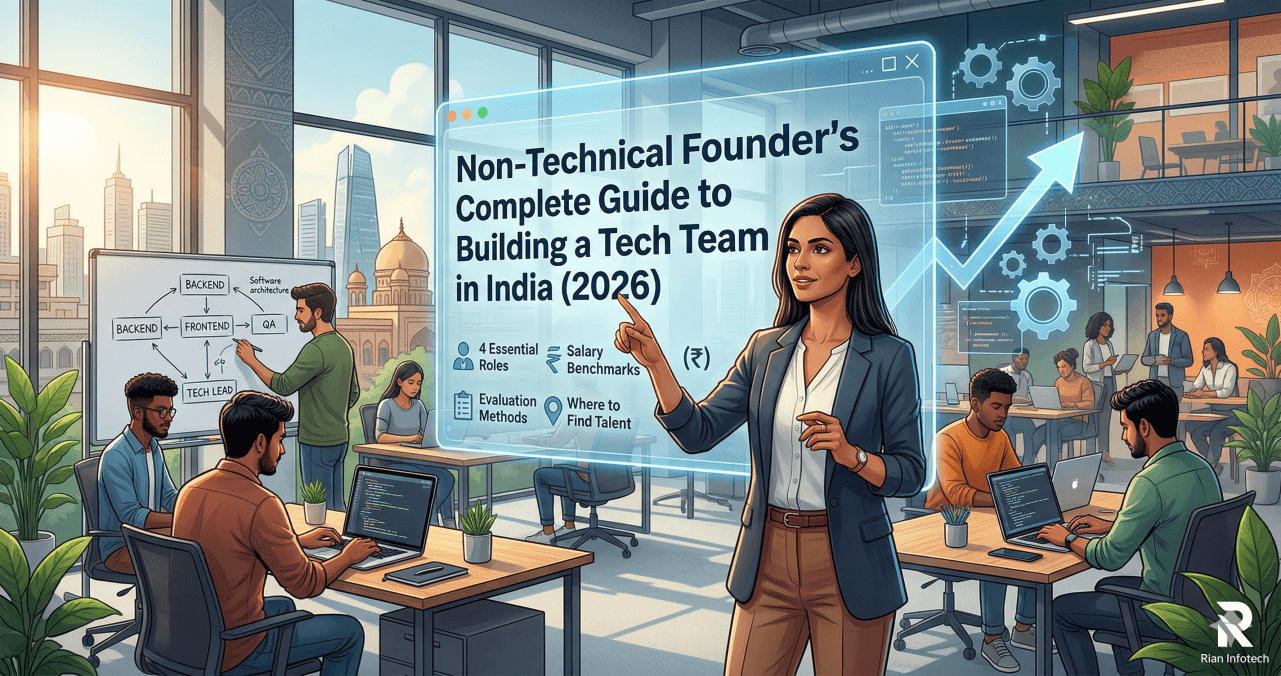
Non-Technical Founder's Complete Guide to Building a Tech Team in India (2026)
You have the idea, the market research, maybe even your first paying customers. But when it comes to building the product — actually hiring the people who will write the code — you're operating mostly on instinct and hope.
You don't know if the developer quoting you ₹80,000/month is good or overpriced. You don't know which hire to make first. You've heard horror stories about founders who wasted 6 months and ₹15 lakh on a team that delivered almost nothing.
This guide is for you. It's written specifically for non-technical founders building their first tech team in India in 2026 — covering who to hire, what to pay, where to find them, and how to evaluate quality without reading a single line of code.
Why Getting Your First Technical Hire Wrong Is So Expensive
Most non-technical founders underestimate the compounding cost of a bad technical hire. It's not just the salary.
A developer who writes poor-quality code creates technical debt — problems hidden underneath the surface that slow every future developer down. A codebase built without any architecture discipline can take 3–6 months to untangle before new features can be added cleanly. That's 3–6 months of developer salaries spent not moving forward.
Beyond that, bad technical hires damage your ability to hire good ones. Senior engineers look at a codebase before joining — and they decline when they see the mess.
The pattern is always the same: a founder hires fast (usually someone they found through a personal reference), gives them too much autonomy too early, and discovers the problem 4–6 months later when nothing works and the developer has already left.
Getting this right from the start isn't just an engineering problem. It's a business survival problem.
The 4 Roles You Actually Need — And In What Order
Most early-stage Indian startups need the same 4 types of technical talent. The order matters more than most founders realise.
1. Backend Developer (Hire First)
Your backend developer builds the core of your product — the logic, database, and APIs. Everything else connects to what they build. If you get this person wrong, every subsequent hire is building on a shaky foundation.
What to look for: 2–4 years of experience, a strong portfolio with production applications (not just tutorials), fluency in at least one backend language (Node.js, Python, or PHP for most Indian startups), and the ability to explain technical trade-offs in plain English.
Typical 2026 cost: ₹60,000–₹1,20,000/month (remote); ₹80,000–₹1,50,000/month (Bengaluru/Mumbai in-office)
2. Frontend Developer (Hire Second)
Once your backend exists, your frontend developer builds what users see and interact with. For many B2C products, the frontend is the product experience — poor UI/UX can tank retention regardless of how solid the backend is.
What to look for: Strong React or Flutter skills depending on your platform (web vs. mobile), experience with responsive design, and — critically — an eye for UI quality. Ask to see 3 live products they've shipped.
Typical 2026 cost: ₹50,000–₹1,00,000/month (remote); ₹70,000–₹1,30,000/month (in-office)
3. QA Engineer or Full-Stack Developer (Hire Third)
At this stage, you have two developers shipping fast and no one catching bugs before they hit users. A QA engineer prevents the embarrassing incidents — broken payment flows, data not saving, UI breaking on mobile.
Alternatively, at this stage some startups hire a second full-stack developer instead of a dedicated QA, giving them more velocity while doubling review capacity.
Typical 2026 cost (QA): ₹40,000–₹80,000/month
4. Technical Lead or Fractional CTO (Hire Early — Not Last)
This is the hire most non-technical founders make too late. A technical lead or Fractional CTO provides architectural oversight — the person who reviews what everyone else is building and catches systemic problems before they become expensive.
Without this role, your team of 2–3 developers makes independent decisions that collectively create an unmaintainable product. With it, someone is responsible for the overall technical direction.
Typical 2026 cost (Fractional CTO): ₹25,000–₹60,000/month for 10–15 hours/week
Key insight: Most non-technical founders treat the Fractional CTO as a "someday" hire. Treat it as a "Day 1" hire instead — especially if you have no technical co-founder. The cost of not having technical oversight in the first 6 months almost always exceeds the cost of having it.
Where to Find Good Developers in India in 2026
India has no shortage of developers — the challenge is finding good ones at your budget. Here's where to look, ranked by reliability:
LinkedIn (most reliable for mid-senior talent) Use the People search with filters: Location = India, Title = "Backend Developer" or "Full Stack Developer," Current Company = active (to see employed developers — they're more likely to be good). Reach out directly. Expect a 10–15% reply rate.
Internshala and Naukri (best for junior talent) For your first junior developer or intern, Naukri and Internshala have the widest pool. Filter heavily — look for candidates with GitHub profiles and projects you can actually review.
GitHub (highest signal, most effort) Search for Indian developers actively contributing to open-source projects in your relevant stack. Someone with public contributions is demonstrating their actual work — which is far more reliable than any resume.
Referrals from other founders The single highest-conversion channel. Post in founder communities (Slack groups, IIT/IIM alumni networks, startup communities like YourStory's founder network) asking for developer referrals. Referred candidates are 3x more likely to stick.
Freelance platforms (use carefully) Upwork, Toptal, and Contra have genuine talent but require strong filtering. For early-stage startups, the lack of continuity (freelancers juggling multiple projects) is a real operational risk. Use for short-term or one-off work, not for core product development.
How to Evaluate Developers Without Being Technical
This is the most common question non-technical founders ask — and the answer isn't "just trust your gut." Here are four concrete methods:
Method 1: The GitHub Review
Ask every candidate for their GitHub profile before the interview. Look for:
Repositories with actual commits (not just forked projects they never touched)
Commit frequency (consistent work habits vs. bursts followed by months of nothing)
README files (a developer who documents their work communicates well)
You don't need to read the code. You're reading the behaviour.
Method 2: The Live Build Task
Give every shortlisted candidate a small, specific task — ideally something similar to what they'd actually build for you. It should take 3–5 hours maximum. Pay them for it (₹2,000–₹5,000 is standard).
What you're looking for isn't just whether it works. You're looking at how they communicate during the task. Do they ask clarifying questions? Do they tell you when they're stuck? Do they deliver on time?
Method 3: The Explanation Test
In the technical interview, ask them to explain one thing they built in their portfolio — not what it does, but how they built it and what they'd do differently. A strong developer can explain technical decisions in plain English. If they can't explain it to you, they probably can't explain it to your team either.
Method 4: Hire a Technical Reviewer
If you have no technical co-founder or Fractional CTO, pay a senior developer ₹3,000–₹5,000 to spend 45 minutes reviewing a candidate's take-home project and asking technical questions. This one-time cost can save you months of salary on a bad hire.
Salary Benchmarks for India in 2026
These are realistic market rates for hiring in India remotely or in Tier 1 cities. They reflect 2026 market conditions, not the inflated 2021–22 numbers many salary guides still quote.
Role | Remote (India-wide) | Bengaluru / Mumbai |
|---|---|---|
Junior Backend Developer (0–2 yrs) | ₹30K–₹55K/mo | ₹40K–₹70K/mo |
Mid Backend Developer (2–5 yrs) | ₹60K–₹1.0L/mo | ₹80K–₹1.3L/mo |
Senior Backend Developer (5+ yrs) | ₹1.0L–₹1.8L/mo | ₹1.3L–₹2.2L/mo |
Junior Frontend Developer | ₹25K–₹50K/mo | ₹35K–₹65K/mo |
Mid Frontend Developer | ₹50K–₹90K/mo | ₹65K–₹1.1L/mo |
Full-Stack Developer (mid) | ₹60K–₹1.1L/mo | ₹80K–₹1.4L/mo |
QA Engineer (mid) | ₹40K–₹75K/mo | ₹50K–₹90K/mo |
Fractional CTO / Tech Lead | ₹25K–₹60K/mo | ₹30K–₹70K/mo |
A note on equity: For early hires taking below-market salaries, equity is increasingly expected. 0.25%–1.0% is a standard range for the first 2–3 technical hires at pre-seed stage. If you're paying market rate, equity is optional but still a strong retention signal.
5 Red Flags to Watch For
After reviewing hundreds of developer hires across client companies, these are the patterns that almost always end badly:
1. They can't explain their portfolio projects clearly. If a developer struggles to describe what they built and why, they either didn't build it or don't understand it well enough to maintain it.
2. They quote a fixed price with zero scope conversation. A developer who quotes you ₹3 lakh for your app without asking a single clarifying question is quoting based on templates, not your actual problem.
3. They push back on code reviews. Ask every candidate how they feel about having their code reviewed. Resistance at the interview stage only gets worse once they're employed.
4. No version control history. If they don't use Git consistently, every project they touch is effectively unauditable. This is a non-negotiable standard in 2026.
5. They've never shipped anything live. Tutorial projects and internship work are not equivalent to running production systems. Ask for URLs. Click them. If nothing is live, ask why.
The Biggest Mistake Non-Technical Founders Make
It's not hiring the wrong person. It's hiring without technical oversight.
Even the right developer, with no technical lead reviewing their work, will make decisions that trade long-term maintainability for short-term speed. This is not negligence — it's human nature when there's no review process.
The founders who build great tech teams share one trait: they get technical oversight in place before they need it. Whether that's a Fractional CTO, a senior technical advisor, or a formal code review process, the structure has to exist before the team does.
If you're building your first team right now, the single highest-leverage thing you can do is get technical oversight in place before you make any other hire.
Download: The Tech Team Checklist
We've condensed everything in this guide into a single, printable checklist — covering the 4 hires, the red flags, the evaluation methods, and the salary ranges.
→ Download the Tech Team Checklist (PDF)
Use it before every developer interview. It takes 3 minutes to review and prevents months of mistakes.
Build With the Right Technical Foundation
At Rian Infotech, we work with non-technical founders as their Fractional CTO — providing the technical oversight and hiring support that turns a good idea into a well-built product.
If you're about to make your first technical hire (or your team is already built and you're not sure it's on solid ground), we offer a free 30-minute Technical Health Check.
Frequently Asked Questions

Rishav Shankar
Rishav Shankar is a calm-tech architect who blends AI, engineering, and psychology to design systems that think before they act. He builds products that turn complex human problems into intuitive digital experiences, redefining how founders and teams operate. At the intersection of automation, strategy, and imagination, Rishav is creating the future one intelligent workflow at a time.
Comments
Loading...