A full-time CTO at a funded Indian startup now costs ₹30–50 lakh a year plus equity. A fractional CTO can give you the same seniority of judgement — the architecture call, the hiring filter, the "don't build that" veto — for a fraction of that, often under ₹2 lakh a month. The gap is why fractional leadership has quietly become one of the most common ways early-stage founders in India buy technical horsepower in 2026.
But "a fraction of the cost" is a slogan, not a budget line. Founders still ask me the same three questions every week: what does it actually cost, what am I paying for, and how do I know it's worth it? This guide answers all three with real 2026 benchmarks — both the global market and the India-specific numbers — so you can walk into that conversation knowing what a fair price looks like.
Why This Matters Right Now
Two things collided in 2026. First, seed-stage capital in India got healthier — early-stage funding grew roughly 18% year-on-year to around $478 million in H1 2026, with median seed tickets holding steady near $1 million. More seed-funded companies means more founders who suddenly have money to build but no senior technical person to spend it wisely.
Second, the war for senior tech talent came back. When a company like Sarvam AI raises, it hunts for the top 1% of engineers, and that pressure ripples down the market. A great full-time CTO is expensive, slow to hire, and often uninterested in a pre-product-market-fit startup. So a founder is left with a painful choice: overpay for a full-timer they can't fully utilise, or muddle through with an agency and hope the architecture doesn't collapse at scale.
The fractional CTO exists precisely in that gap — senior leadership on a part-time cadence, priced so a seed-stage company can actually afford it. Getting the cost math right is the difference between a smart hire and an expensive advisor who bills for calls.
The 2026 Benchmarks: What a Fractional CTO Actually Costs

Let's separate the global picture from the India reality, because the numbers are very different.
Globally (US/Europe, 2026): monthly retainers cluster between $9,000 and $25,000, with the median around $12,000–$18,000 for 15–25 hours a week. Hourly rates average about $213, ranging from $150 to $500. Day rates run $1,500–$4,000. Specialist domains — AI, fintech, healthtech — carry a 20–40% premium.
In India (2026): the same seniority costs dramatically less. India and Southeast Asia rates run roughly 50–70% below US rates. Translated to rupees, here is the range I see holding across the market:
Engagement type | Time commitment | Typical India cost (2026) | Best for |
|---|---|---|---|
Advisory retainer | 2–6 hours/week | ₹50,000 – ₹1,00,000/month | Idea validation, stack decisions, occasional review |
Hands-on build lead | ~2 days/week (16 hrs) | ₹1,50,000 – ₹2,50,000/month | MVP build, first hires, roadmap ownership |
Specialist / AI-heavy | 2–3 days/week | ₹2,50,000 – ₹3,50,000+/month | Applied AI, fintech, high-scale or regulated systems |
Day rate (project) | Per day | ₹15,000 – ₹40,000/day | Architecture reviews, due diligence, one-off audits |
Hourly | Per hour | ₹4,000 – ₹12,000/hour | Light, unpredictable needs |
A useful anchor: the "standard" fractional engagement worldwide is scoped at roughly 16 hours a week — two focused days of senior leadership. In India, that lands most founders in the ₹1.5L–₹2.5L/month band. If someone quotes you far above ₹3.5L for part-time work without a clear specialist reason, ask what justifies the premium.
What Actually Drives the Price
Two fractional CTOs can quote numbers 3x apart for what sounds like the same job. The gap is almost always explained by four variables.
1. Time commitment and cadence
The single biggest lever. Six hours a week and two days a week are different jobs. Be honest with yourself about how much senior attention your stage actually needs — most pre-seed companies over-buy hours they can't feed with real decisions.
2. Hands-on vs. advisory
An advisor who joins two calls a week and reviews your architecture is priced very differently from someone writing production code, running your sprints, and interviewing engineers. Decide which you're buying before you compare quotes, or you'll be comparing apples to servers.
3. Domain specialisation
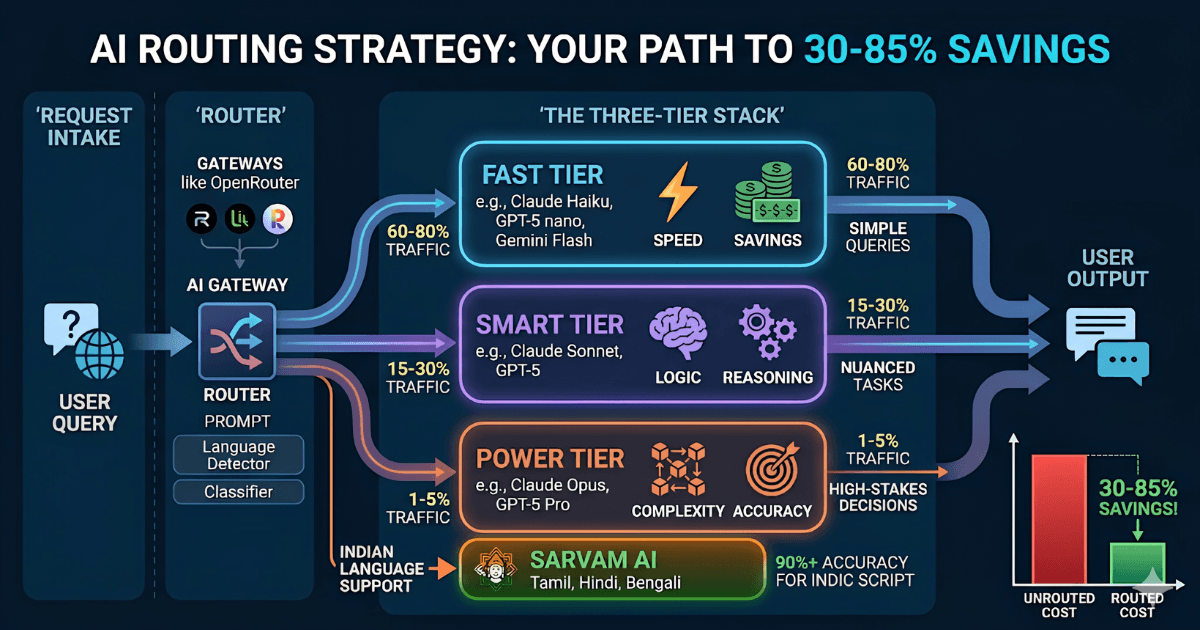
Applied AI, fintech, and regulated or high-scale systems carry a real premium — 20–40% globally, and a similar bump in India. If your product lives or dies on retrieval quality, model cost, or payment compliance, paying for that expertise is cheaper than paying to rebuild later. This is the same logic behind sound LLM cost and model-routing decisions — getting the architecture right early saves multiples down the line.
4. Seniority and track record
Someone who has scaled a system to millions of users, or shipped AI into production at a real company, prices above a generalist — and should. The question isn't "who's cheapest," it's "whose judgement will save me the most money over the next 12 months."
Fractional vs. Full-Time: The Real Cost Comparison

Here is where fractional pricing stops looking like an expense and starts looking like arbitrage. A full-time CTO at an Indian seed-to-Series A startup runs ₹30–50 lakh a year in salary — ₹3.5L to ₹6L a month all-in — plus a meaningful ESOP grant. Funded startups often push that to ₹6L–₹10L a month.
Full-time CTO (India) | Fractional CTO (India) | |
|---|---|---|
Annual cash cost | ₹30–50 lakh+ | ₹6–30 lakh |
Equity dilution | 0.5–2%+ ESOP typical | Usually none (or nominal) |
Time to onboard | 2–5 months to hire | 1–2 weeks |
Commitment / exit | Notice period, severance risk | Monthly, flexible |
Best fit | 8–12+ engineers, daily leadership | Pre-Series A, part-time judgement |
The honest caveat: a fractional CTO is not a full-time CTO. If your engineering org has grown past a dozen people and needs someone in the trenches every day owning delivery and culture, you've outgrown the model. The fractional version wins decisively before that point — when you need senior decisions more than you need daily presence.
How to Run the ROI Math
Cost is only half the equation. The reason fractional leadership pays for itself is that senior technical judgement prevents expensive mistakes — and prevented mistakes are the return.
Think of it in three buckets:
Rebuild avoided. A wrong stack or architecture choice at month three can cost 6–12 months of engineering to unwind. If a ₹2L/month CTO steers you away from one such mistake, they've paid for a year in a single decision.
Hiring accuracy. A bad senior engineering hire in India can cost ₹15–25 lakh in salary, ramp, and opportunity before you correct it. A fractional CTO who screens your first three hires protects far more than their fee.
Burn efficiency. Founders routinely overspend on cloud, tooling, and AI API bills simply because no one senior is watching. Tightening that — the same discipline we describe in our fractional CTO guide for Indian startups — often recovers the retainer outright.
A simple test: estimate the single most expensive technical mistake you could make in the next 12 months. If a fractional CTO's annual cost is a fraction of that number — and it almost always is — the ROI question answers itself.
When to Hire One (and When Not To)

A fractional CTO is the right call when: you're a non-technical founder validating an MVP; you're inheriting or cleaning up an outsourced/agency build; you need to make a stack or architecture decision you can't reverse cheaply; you're about to make your first senior engineering hires; or you need technical credibility for a fundraise or due-diligence process.
It's the wrong call when: you have 10+ engineers who need daily hands-on leadership; your product requires deep, continuous, full-time ownership; or you're using "fractional" as a way to avoid committing to the technical function your business fundamentally depends on. In those cases, budget for a full-timer.
Quick-Win Action Steps
Define the job before the budget. Write one sentence: "I need someone to ___ for about ___ hours a week." Advisory or hands-on. That sentence determines your band.
Benchmark against the table above. Advisory ₹50k–₹1L, hands-on ₹1.5L–₹2.5L, specialist ₹2.5L–₹3.5L+. Anything wildly outside needs a reason.
Ask what's included — in writing. Hours, coding vs. advisory, hiring support, on-call, response time. Most disputes come from unstated scope.
Run the one-mistake ROI test. Name the costliest technical error you could make this year; compare it to the annual retainer.
Start monthly, not annual. The flexibility is the point. A 30-day rolling engagement lets you scale up, down, or out as your stage changes.
The Bottom Line
In 2026, a fractional CTO in India costs most founders between ₹50,000 and ₹3,00,000 a month — roughly half to a third of a full-time equivalent, with none of the equity dilution or hiring lag. But the number on the invoice is the least interesting part. What you're really buying is judgement priced by the day instead of the year: the architecture call that saves a rebuild, the hire you didn't botch, the cloud bill nobody was watching. Price it against the mistake you'd otherwise make, and the math is rarely close.
Ready to implement this for your business? Talk to the Rian Infotech team →
Frequently Asked Questions

Rishav Shankar
Rishav Shankar is a calm-tech architect who blends AI, engineering, and psychology to design systems that think before they act. He builds products that turn complex human problems into intuitive digital experiences, redefining how founders and teams operate. At the intersection of automation, strategy, and imagination, Rishav is creating the future one intelligent workflow at a time.
Comments
Loading...