Staying current with the rapidly evolving AI and Python landscape is no longer a luxury—it's a necessity that directly impacts your ability to ship faster, build more reliable systems, and maintain a competitive career edge. This daily digest is compiled from real-time industry monitoring to bring you the most consequential updates without the noise.
1. Major AI & Python Updates
This section distills the most consequential platform and language-level updates from the past 24 hours. These are not minor changes but foundational shifts that impact infrastructure, security, and core model capabilities for developers working on the front lines of AI.
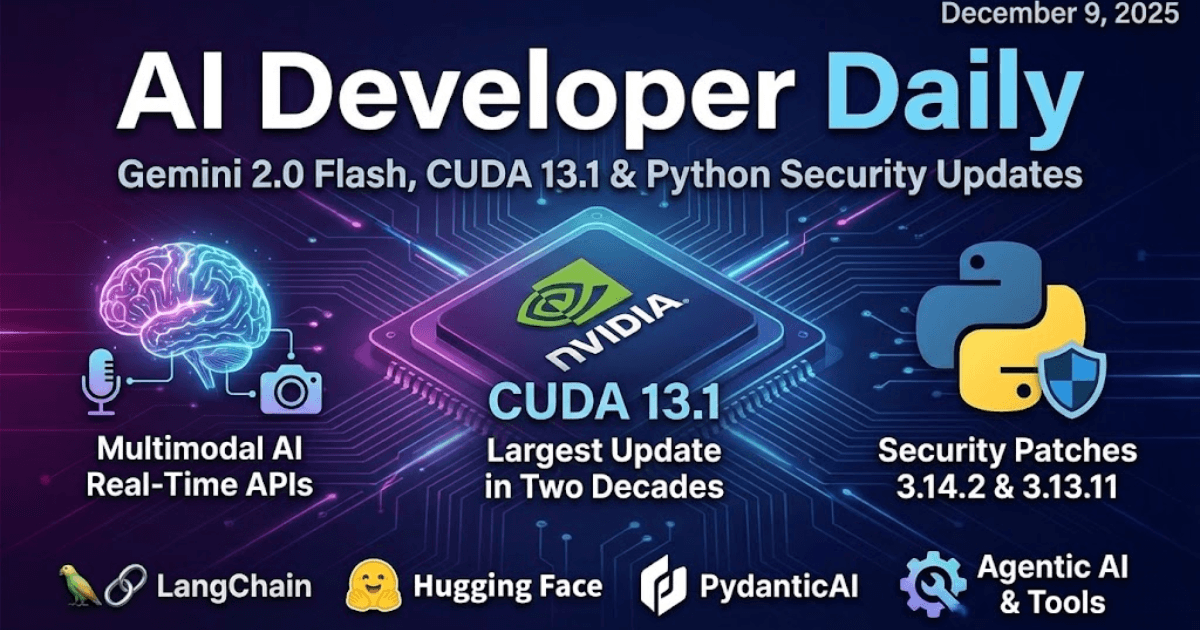
Google Unleashes Gemini 2.0 Flash with Real-Time Multimodal APIs
Google has made Gemini 2.0 Flash available to developers through the Gemini API in Google AI Studio and Vertex AI. The release features native multimodal input and text output, with early access to text-to-speech and native image generation. Critically, the new Multimodal Live API supports real-time audio and video-streaming input, enabling a new class of interactive applications.
Developer Relevance:
Directly enables the creation of production-ready, real-time AI applications that can process live audio and video streams.
Simplifies multimodal workflows by providing a single, native API endpoint, reducing the complexity of integrating separate vision, audio, and text models.
The "Deep Research" feature in Gemini Advanced offers a powerful tool for building AI-driven research assistants with long-context reasoning capabilities.
NVIDIA CUDA 13.1: Largest Update in Two Decades
NVIDIA has launched CUDA 13.1, marking the largest comprehensive update to the CUDA platform since its inception. The release introduces CUDA Tile IR and cuTile Python, profoundly changing how developers can program and optimize for the next generation of GPUs. New features also include advanced kernel profiling with NVIDIA Nsight Compute 2025.4 and source-level metric mapping.
Developer Relevance:
Provides foundational infrastructure for building and optimizing complex, high-performance AI systems on NVIDIA hardware.
cuTile Python offers a more accessible way for Python developers to write highly optimized GPU kernels, bridging the gap between high-level frameworks and low-level performance tuning.
Enhanced profiling tools allow for deeper inspection and debugging of GPU-bound workloads, which is essential for maximizing the efficiency of training and inference pipelines.
Meta AI Integrates Real-Time News from Major Publishers
Meta has signed commercial AI data agreements with major publishers including CNN, Fox News, USA Today, and Le Monde Group. As a result, Meta AI can now surface real-time news with clickable links to source articles, directly addressing the information latency and hallucination challenges common in large language models.
Developer Relevance:
Represents a significant step toward content-aware AI that can provide timely and verifiable information, reducing the risk of generating outdated or fabricated content.
For developers building RAG (Retrieval-Augmented Generation) systems, this highlights the growing industry trend of integrating licensed, real-time data sources to improve factual accuracy.
The model of providing clickable source links is a best practice for building trustworthy AI applications that allow users to verify information.
Python 3.14.2 & 3.13.11 Security Updates Released
The Python Software Foundation has released Python 3.14.2 and 3.13.11, providing critical security patches and maintenance updates for both the latest and the current stable versions of the language. Both versions were released on December 5, 2025.
Developer Relevance:
Immediate action required: Developers must update their production environments to patch potential security vulnerabilities.
Reinforces the importance of maintaining a secure software supply chain, especially as Python is the backbone of the vast majority of AI and machine learning infrastructure.
Staying current with these releases ensures access to the latest performance improvements and bug fixes.
2. Agentic Development Highlights
Building reliable, autonomous systems is a critical frontier in AI development. This section moves beyond generic news to focus on practical patterns, frameworks, and learnings for creating production-grade AI agents.
LangChain's Learnings on "Deep Agents"
What changed: LangChain shared a detailed post on practical lessons learned from building and shipping complex, tool-heavy agents, with a strong emphasis on robust evaluation and reliability.
Why it matters: This guidance moves the conversation from simple agent prototypes to production-ready systems. It emphasizes the need for task-level metrics (like completion rates and tool-call counts) over simple prompt-response accuracy. Furthermore, it highlights the critical role of structured tracing and checkpoints, which allow developers to inspect, debug, and even rewind agent trajectories when they fail mid-task.
One real use-case example: A developer building a customer support agent could implement a "replay harness." The harness automatically logs every interaction. When a trajectory fails, a developer can use this log to automatically replay the exact scenario against a new model version, creating a powerful regression testing suite.
Shakudo's "AgentFlow" for Production Hardening
What changed: Shakudo detailed its "AgentFlow" architecture, which provides an operational layer for hardening LangChain-style agents with policy guardrails, schedulers, and orchestration features required for production SLAs.
Why it matters: This pattern provides a crucial blueprint for taking agents from prototype to production. It advocates for separating the "agent logic" (reasoning) from the "runtime/ops layer" (scheduling, monitoring, governance).
One real use-case example: A team developing a content generation agent could use AgentFlow to operationalize it. The agent's core logic focuses on research, while the AgentFlow runtime handles the nightly cron schedule, enforces content policies, and manages API key credentials securely.
3. New AI Tools & Libraries
The right tools are essential for translating advanced AI concepts into working applications. This section offers a curated look at the most impactful new library releases.
LangChain v1.0.2
What it does: A comprehensive framework for building LLM-powered applications, providing native support for chaining prompts, managing memory, and executing tools.
How it helps: The v1.0 release line represents a major evolution with a refined agent API and middleware support.
Installation:
Bash
pip install langchainUsage Snippet:
Python
from langchain.agents import load_tools, initialize_agent, AgentType
from langchain.llms import OpenAI

llm = OpenAI(temperature=0)
tools = load_tools(["serpapi", "llm-math"], llm=llm)
agent = initialize_agent(tools, llm, agent=AgentType.ZERO_SHOT_REACT_DESCRIPTION, verbose=True)

agent.run("What is the temperature in San Francisco raised to the 0.2 power?")
huggingface_hub 0.34.4
What it does: Provides programmatic access to over 650,000 models, datasets, and spaces on the Hugging Face Hub. The latest version adds Image-to-Video inference support.
How it helps: A critical tool for accessing cutting-edge open-source models without writing custom API wrappers. The new image-to-video capabilities enable developers to build powerful video automation workflows.
Installation:
Bash
pip install huggingface_hubUsage Snippet:
Python
from huggingface_hub import InferenceClient

client = InferenceClient(token="your_hf_token")
# New Image-to-Video inference
video = client.image_to_video(image="https://example.com/image.png")
video.save("output_video.mp4")
PydanticAI v1.6.0
What it does: A lightweight agent framework that brings type safety and structured output validation to LLM interactions using Pydantic.
How it helps: Solves the "fuzzy LLM" problem. By validating responses at the model level, it eliminates JSON parsing errors and invalid tool calls, significantly reducing debugging time.
Installation:
Bash
pip install pydantic-aiUsage Snippet:
Python
from pydantic import BaseModel
from pydantic_ai import Agent

class CityInfo(BaseModel):
    city: str
    population: int

agent = Agent('openai:gpt-4o', result_type=CityInfo)
result = agent.run_sync('Tell me about Tokyo')
print(result.data.city, result.data.population)
4. Python Tip of the Day
Mastering a language involves not just knowing the syntax but also the elegant patterns that solve common problems efficiently.
Composable defaultdict Factories
This pattern uses collections.defaultdict with lambda functions to automatically build nested data structures, eliminating repetitive key-existence checks.
Python
from collections import defaultdict

# Real-world example: Processing events with automatic grouping
# This creates a 3-level nested dictionary where the final level is a list.
events = defaultdict(lambda: defaultdict(lambda: defaultdict(list)))

for event_type in ['click', 'scroll', 'click']:
    for user_id in [1, 1, 2]:
        timestamp = "2025-12-09T10:00:00Z"
        events[event_type][user_id][timestamp].append({
            'x': 100, 'y': 200
        })

# Accessing a non-existent key returns an empty structure, not a KeyError.
print(events['click'][-1]) # Output: defaultdict(<class 'list'>, {})
When to use it: Powerful for event processing, data aggregation, or streaming pipelines. It is significantly faster (approx. 33% faster) than using dict.setdefault() in a loop over large datasets.
5. Research Snapshot
Today's research papers become tomorrow's production systems.
RL-Struct: A Lightweight Reinforcement Learning Framework
The Idea: Reframes generating structured output (like JSON/SQL) as a reinforcement learning problem.
Developer Relevance: Fine-tune your LLM using a reward function that checks for schema adherence against a Pydantic model to harden agent reliability.
Assertion-Conditioned Compliance
The Idea: Identifies a vulnerability where AI agents over-trust outputs from previous tool calls.
Developer Relevance: Tag every intermediate fact with its provenance (which tool produced it) and implement guard functions that re-validate critical data before database writes.
Closing Section
Synthesizing today's updates reveals several key themes. The industry is rapidly moving toward real-time multimodal AI, as evidenced by Gemini 2.0. The strong adoption of transparent, modular AI infrastructure continues, and foundational updates to the Python ecosystem (CUDA 13.1, Security Patches) provide the backbone required to build these sophisticated systems.

Rishav Shankar
Rishav Shankar is a calm-tech architect who blends AI, engineering, and psychology to design systems that think before they act. He builds products that turn complex human problems into intuitive digital experiences, redefining how founders and teams operate. At the intersection of automation, strategy, and imagination, Rishav is creating the future one intelligent workflow at a time.
Comments
Loading...