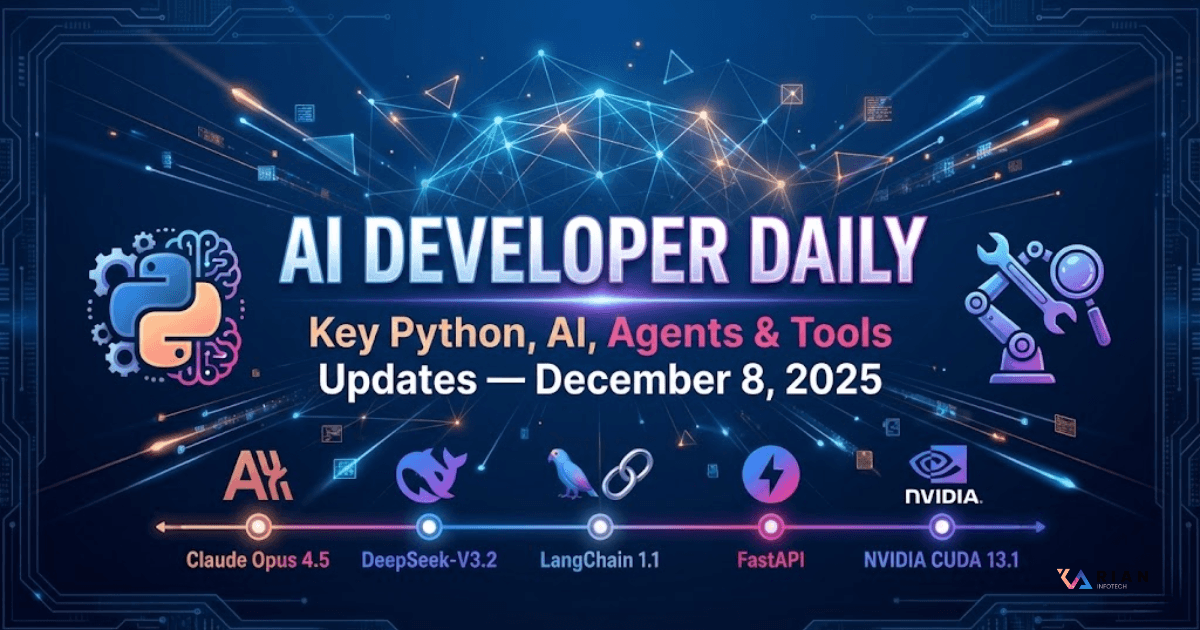
AI Developer Daily — Key Python, AI, Agents & Tools Updates for December 8, 2025
In the rapidly evolving AI and Python landscape, staying current is no longer optional—it's the critical factor determining your shipping speed, system reliability, and professional growth. This daily digest cuts through the noise, curating the most strategically important updates from comprehensive, real-time industry monitoring.
1. Major AI & Python Updates
The AI landscape is defined by rapid advancements from major model providers and foundational framework updates. This section distills the most strategically important releases for developers from the last 24 hours, focusing on capabilities that directly impact system architecture and performance.
Anthropic Launches Claude Opus 4.5 with Advanced Tool-Calling
Anthropic's Claude Opus 4.5, launched November 24, 2025, introduces significant enhancements for agentic workflows, further solidifying its role in enterprise development. The latest updates include programmatic tool calling (now in public beta), which enables models to execute tools directly from within code. This reduces latency and token usage in complex, multi-tool scenarios.
Developer Relevance:
- Reduced Latency: Programmatic tool calling minimizes round-trip delays for multi-step agentic tasks.
- Cost & Performance Control: A new effort parameter allows developers to make explicit trade-offs between response thoroughness and token efficiency at inference time.
- Dynamic Tooling: The introduction of "tool search" enables agents to discover and load necessary tools on-demand from large catalogs, creating more flexible and scalable systems.
Source: [https://www.anthropic.com/news/claude-opus-4-5](https://www.anthropic.com/news/claude-opus-4-5)
DeepSeek-V3.2 Integrates Reasoning Directly into Tool Use
DeepSeek released V3.2 on December 1, 2025, introducing a novel "Thinking in Tool-Use" capability. This approach integrates reasoning directly into the tool-use process, leveraging massive agent training data synthesized from over 1,800 environments. The model also features DeepSeek Sparse Attention (DSA), which achieves a 50%+ cost reduction for long-context processing.
Developer Relevance:
- Simplified Agent Orchestration: By embedding reasoning into tool execution, developers can build more reliable multi-step agents without needing complex, separate chain-of-thought orchestration layers.
- Significant Cost Savings: The DSA architecture and a refined Mixture-of-Experts (MoE) system dramatically lower the cost of processing long contexts, a common requirement in RAG and agentic workflows.
- Elite Reasoning Capabilities: A Speciale variant provides reasoning performance competitive with top-tier models on complex domains, making advanced capabilities more accessible.
Source: [https://api-docs.deepseek.com/news/news251201](https://api-docs.deepseek.com/news/news251201)
LangChain 1.1 Delivers Enhanced Reliability and Moderation
LangChain v1.1.0, launched December 1, 2025, introduces a model-profile system that exposes a .profile attribute describing a model's supported features (e.g., structured output, function calling). This enables developers to build more robust agents that can declaratively adapt to different model capabilities.
Developer Relevance:
- Declarative Agent Building: By leveraging models.dev—an open-source index of model behaviors—agents can now declaratively adapt to the specific features of an underlying LLM, reducing runtime errors.
- Improved Resilience: Built-in retry logic with configurable exponential backoff provides greater resilience when interacting with potentially flaky model endpoints.
- Integrated Safety: New content moderation middleware can be applied to user inputs, model responses, and tool outputs, simplifying the implementation of safety guardrails.
FastAPI 0.123.5 Introduces Breaking Changes to Coroutine Handling
The latest FastAPI release, version 0.123.5, includes important updates and breaking changes related to its handling of coroutines and dependencies. The update also streamlines cloud deployment with the inclusion of the fastapi-cloud-cli.
Developer Relevance:
- Improved Dependency Management: The release adds better support for wrapped functions that use functools.wraps(), making it easier to build modular and decorated dependency logic without conflicts.
- Streamlined Deployment: The fastapi[standard] installation now includes a CLI for deploying directly to FastAPI Cloud, simplifying the path from development to production.
- Awareness Required: As a breaking change, developers upgrading to this version will need to review and potentially update their existing coroutine and dependency handling code.
Source: [https://fastapi.tiangolo.com/release-notes/](https://fastapi.tiangolo.com/release-notes/)
NVIDIA CUDA 13.1 Released with New Tile-Based Programming Model
NVIDIA's CUDA 13.1, released December 4, 2025, represents a major update to the GPU programming ecosystem. Its headline feature is CUDA Tile, a new tile-based programming model that abstracts specialized hardware like tensor cores, making it easier for developers to write highly optimized kernels.
Developer Relevance:
- Simplified Performance Tuning: CUDA Tile allows developers to leverage specialized hardware more easily, unlocking performance gains without deep hardware-specific knowledge.
- Enhanced Profiling: Nsight Compute 2025.4 adds detailed profiling for CUDA Tile kernels, providing clear visibility into performance characteristics.
- Improved Debugging: NVIDIA Compute Sanitizer 2025.4 now supports compile-time patching for enhanced memory error detection, improving code quality and stability.
These foundational updates directly enable more sophisticated systems, particularly in the burgeoning field of agentic development.
2. Agentic Development Highlights
Agentic systems are rapidly moving from experimental prototypes toward production-grade applications. This section dives into the latest architectural patterns, frameworks, and research that are driving this shift toward greater reliability, predictability, and efficiency.
### The EnCompass (PAN) Framework for Reliable Workflows
- What Changed: The EnCompass framework introduces a "Programmable Agent Networks" (PAN) model. It compiles standard Python agent programs, which have explicit control flow and state management, directly into optimized and executable workflow graphs.
- Why It Matters: This approach aims to reduce the non-determinism inherent in prompt-driven agent orchestration. By compiling the workflow, developers gain stronger guarantees about execution order, data dependencies, and failure modes, making agents more predictable and easier to debug.
- Real-World Use Case: Implement a "Compiled Orchestrator" pattern where each step of an agent's process (plan, tool-select, execute) is a decorated Python function. This entire orchestrator is then compiled into a static workflow graph that can be versioned, reviewed, and locked for production, ensuring stable and auditable behavior.
The AgentX Pattern for Robust Orchestration
- What Changed: AgentX is an architectural pattern that decomposes complex tasks using three specialized agents: a Stage Generator to define high-level phases, a Planner to detail steps within each stage, and an Executor to perform the actions. A key feature is strict tool filtering, where only a subset of relevant tools is available at each stage.
- Why It Matters: This separation of concerns simplifies the prompting for each agent and dramatically reduces the risk of hallucinated or incorrect tool usage. By narrowing the toolset available to the Executor at any given stage, developers can cut token costs and improve selection accuracy.
- Real-World Use Case: Create a "Stage-Scoped Tool Budget" controller. The Stage Generator first outlines the task's phases (e.g., "Data Ingestion," "Analysis," "Report Generation"). For each stage, the controller computes the minimal tool subset required and passes only that subset to the Executor agent, preventing it from accessing irrelevant or dangerous tools.
Key Findings from the GitTaskBench Benchmark
- What Changed: GitTaskBench is a new benchmark for code agents based on 54 real-world repository tasks. The research reveals that even state-of-the-art agents fail frequently, not due to poor reasoning, but due to common workflow issues like environment setup and dependency handling.
- Why It Matters: This finding forces a critical shift in focus for developers building agentic systems. Robustness depends less on the core LLM's intelligence and more on the orchestration layer's ability to manage the environment, handle failures, and validate preconditions. The benchmark also introduces an "alpha-value" metric to evaluate if an agent is truly more cost-effective than a human developer.
- Real-World Use Case: Implement an "Environment-Sentinel Agent" as a preliminary step in any coding workflow. This specialized agent is responsible for validating preconditions (e.g., dependencies installed, tests passing), running probes after each major change pip check), and reporting structured failure types that the main orchestrator can use for targeted recovery actions.
Building these sophisticated agentic patterns requires robust, specialized tools and libraries designed for the task.
3. New AI Tools & Libraries
While major models provide raw capability, developer velocity often depends on the quality of the surrounding tools and libraries. This section highlights impactful new releases that solve specific, real-world development challenges.
Pydantic AI v1.27.0
- What It Does: An agent framework that tightly integrates Pydantic's renowned data validation with large language models, enabling developers to build reliable, typed AI agents that produce structured outputs.
- How It Helps Developers: It dramatically simplifies the process of getting structured, validated data back from LLMs. Native support for multiple providers and features like thinking parts and multi-agent orchestration make it essential infrastructure for building production-grade agents.
- Installation: pip install pydantic-ai
- Usage Snippet:
- Source: [https://github.com/pydantic/pydantic-ai/releases](https://github.com/pydantic/pydantic-ai/releases)
### RAG-Anything v1.2.8
- What It Does: An all-in-one multimodal RAG framework designed to process text, images, tables, equations, and charts within a single, unified pipeline.
- How It Helps Developers: It eliminates the need to stitch together multiple specialized tools for handling complex documents. By consolidating OCR, table extraction, and multimodal embeddings into one framework, it provides a production-ready solution for enterprise knowledge management where mixed-content documents are the norm.
- Installation: pip install raganything
- Source: [https://github.com/HKUDS/RAG-Anything](https://github.com/HKUDS/RAG-Anything)
### Dialz: A Python Toolkit for Steering Vectors
- What It Does: A Python library for researching and applying steering vectors, which allow developers to modify an LLM's activations at inference time to amplify or weaken specific concepts like honesty or positivity without retraining the model.
- How It Helps Developers: It provides a powerful, interpretability-focused method for controlling model behavior. The library's built-in visualization tools help developers understand which tokens are driving steering interventions, making it invaluable for building safer and more controllable AI applications.
- Installation: pip install dialz
- Source: [https://aclanthology.org/2025.acl-demo.35/](https://aclanthology.org/2025.acl-demo.35/)
These practical tools are grounded in foundational research, which continues to push the boundaries of what's possible.
5. Research Snapshot
This section bridges the gap between academic research and practical application, highlighting impactful papers that signal future trends in AI development.
Arbitrage: Efficient Reasoning via Advantage-Aware Speculation
This paper proposes a decoding framework where a small, efficient model cheaply speculates on candidate reasoning steps, and a larger, more powerful model only intervenes to verify or correct the most promising paths. This "arbitrage" approach significantly reduces the compute cost and latency of generating high-quality, multi-step reasoning chains. For developers, this pattern can be implemented as a two-model Python pipeline to dramatically lower API costs for reasoning-heavy tasks like multi-hop Q&A or complex tool use, without sacrificing output quality.
Source: [https://arxiv.org/abs/2512.05033](https://arxiv.org/abs/2512.05033)
GTM: Simulating the World of Tools for AI Agents
GTM introduces a simulator that creates realistic, executable tool environments for training and evaluating AI agents. This allows agents to be trained on large-scale, complex tool-use tasks (like API calling, planning, and troubleshooting) without the risk or expense of interacting with real-world systems. This is directly applicable for developers building production agents; you can use GTM-style abstractions to define sandboxed tools (e.g., mock HTTP servers, filesystems) to generate safe training data and validate new agentic workflows before connecting them to live infrastructure.
Source: [https://arxiv.org/abs/2512.04535](https://arxiv.org/abs/2512.04535)
These research trends point toward a future of more efficient, reliable, and testable AI systems.
Final Thoughts
Today's updates converge on three critical themes for developers. First, the line between reasoning and tool-use is dissolving, with models like Claude Opus 4.5 and DeepSeek-V3.2 embedding logical steps directly into their execution capabilities. Second, the ecosystem is making a decisive pivot toward production-grade reliability, evidenced by LangChain's resilience features and the emergence of structured agentic patterns like EnCompass and AgentX. Finally, the tooling around AI is maturing, abstracting away complex challenges in structured data, multimodal RAG, and model control. For developers, the message is clear: the frontier is no longer just about capability, but about building robust, efficient, and predictable systems.

Rishav Shankar
Rishav Shankar is a calm-tech architect who blends AI, engineering, and psychology to design systems that think before they act. He builds products that turn complex human problems into intuitive digital experiences, redefining how founders and teams operate. At the intersection of automation, strategy, and imagination, Rishav is creating the future one intelligent workflow at a time.
Comments
Loading...