A LinkedIn system for coaches and consultants

It will not tell somebody a thing it has not checked.

Most tools help you send more. The expensive problem is not volume, it is the message that turns out to be wrong. One confident sentence about a company that already shut down, and the conversation is over before it starts.

  • Recorded on a working account
  • Nothing posts on your behalf
  • Every number opens into its parts

What checking actually changes

The same prospect, written twice.

!Unchecked research
“Congrats on the Series A, Rahul. How’s the hiring push going as you scale the engineering team in Pune?”

The research said he ran a Series A company with forty engineers. It came from an undated web page. He had wound the company down eight days earlier, and said so in a post.
Checked against its sources
“Saw your post about winding down Nexaform Robotics last month, that can’t have been an easy call. What are you thinking of building next in Pune?”

Same research, same prospect. The Series A claim could not be traced to any source actually held, so it was dropped before a word was written.

verified from a post, 8 days old

Verification did not make the message blander. It made it usable. A writer that can trust its facts will actually use them.

Watch it work

Nine minutes, on a real account, with nothing staged.

The weekly plan and the comment draft are generated while the recording runs, waits included. Names are pixelated because they belong to other people, not because anything here is a mock-up.

If any of these is you

Six sentences we hear from consultants, and what happens to each.

“I comment every day and I have no idea if any of it works.”

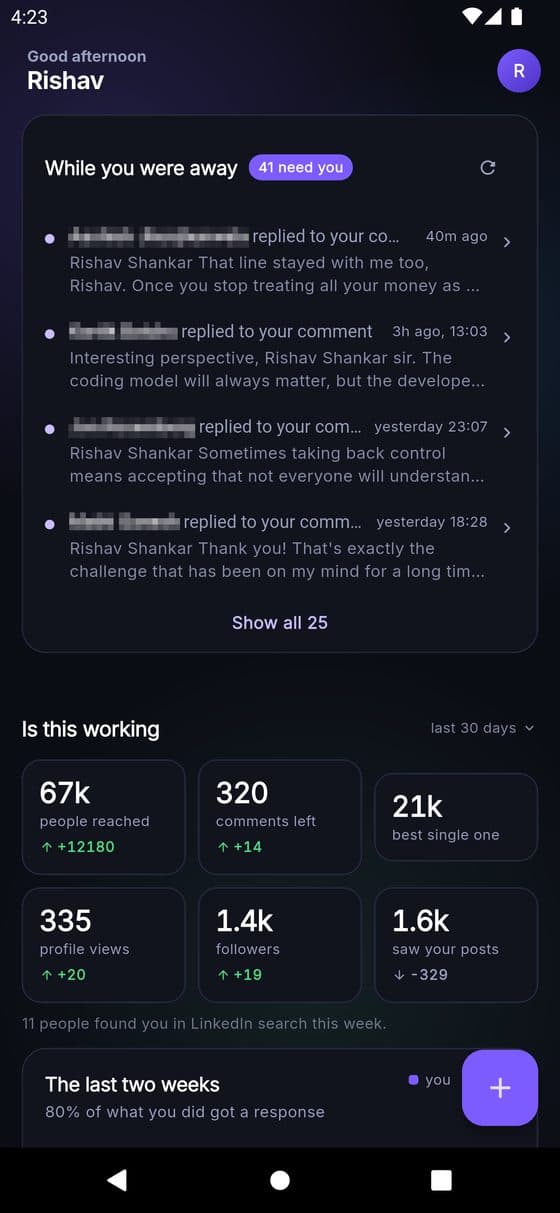
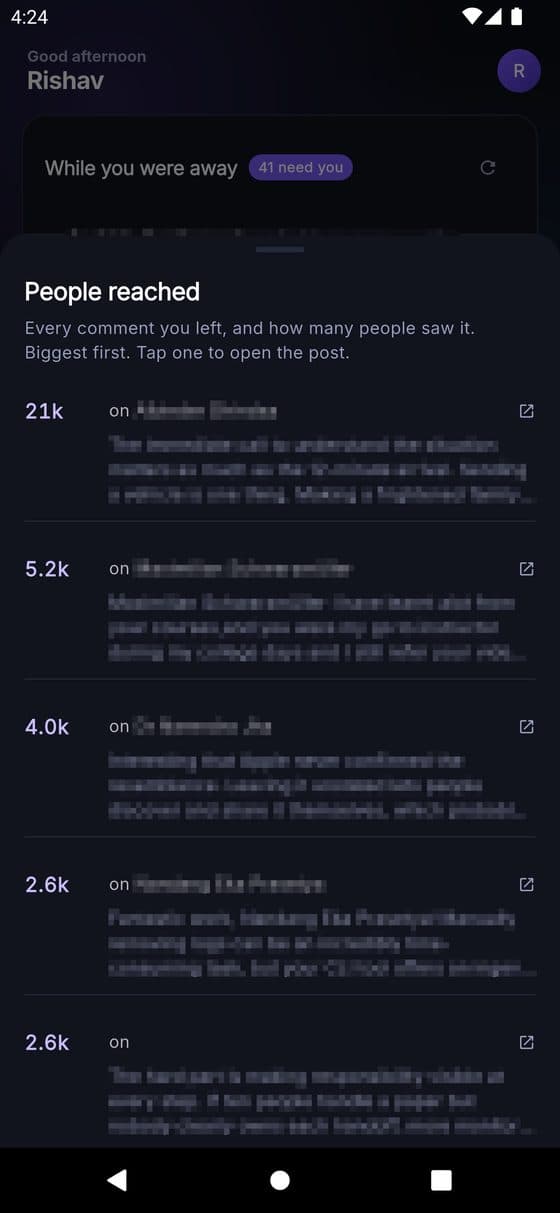
Six numbers on the home screen, and every one opens into the comments that made it. Reach stops being a claim and becomes a list you can read.

“The AI tools write things I would be embarrassed to send.”

It drafts from what you said you sell and who you sell to, and every alternative carries the reason it took that angle. You choose between arguments, not paragraphs.

“People engage with my posts and I never follow up.”

Everyone who reacted or replied is collected in one place, ranked, with the ones already in your leads marked. Most of them are not on anybody's list yet.

“Researching one person properly takes me twenty minutes.”

It reads the public trail, quotes the buying signal from their own words, and tells you plainly where the public data ran out. What each further step costs is on screen before you spend it.

“My CRM is a spreadsheet I stopped updating in March.”

The inbox reads the threads themselves and works out the stage. Teardown due, talking, no reply yet. Nothing depends on you remembering to log anything.

“I have no idea what these AI tools are costing me.”

A running total by the job each call did, and what is left with each provider, taken straight from them. That last number is the one that decides whether tomorrow works.

How the day actually goes

Twelve minutes in the morning, twelve in the evening.

  1. Three questions, and it stops guessing

    What you sell, who you sell it to, and the sentence your buyers would actually say when they complain. Every writer in the product reads these first, so getting them wrong makes every draft wrong the same way.

  2. It finds people worth talking to

    A structured founder search by title, seniority, function and country. Or the automatic one, which finds the creators your buyers already follow and collects the people commenting underneath.

  3. Starting with the ones who already raised a hand

    Everyone who reacted to or replied to something you wrote, ranked, with how many are not on anybody's list yet. They read you and responded. Most tools throw this away and go and buy a colder list.

  4. It checks before you speak

    A buying signal quoted from their own words, not inferred from a job title. And a dossier that says plainly where the public data ran out, rather than filling the gap with something plausible.

  5. You say something worth reading

    The comment queue is ordered by how fast each post is still moving, because a late comment is shown to almost nobody. It drafts in your voice; you paste it. Nothing posts on your behalf.

  6. And every morning, one question

    What arrived while you were away, and whether any of it is working. Counted from the records themselves, not from a log you have to remember to write.

Every screen is one tap from the last

A home screen you can only look at is a poster.

Each number, each row and each name goes somewhere. Taken on a working account. Names are blurred because they belong to other people.

Forty one things need you

The morning screen

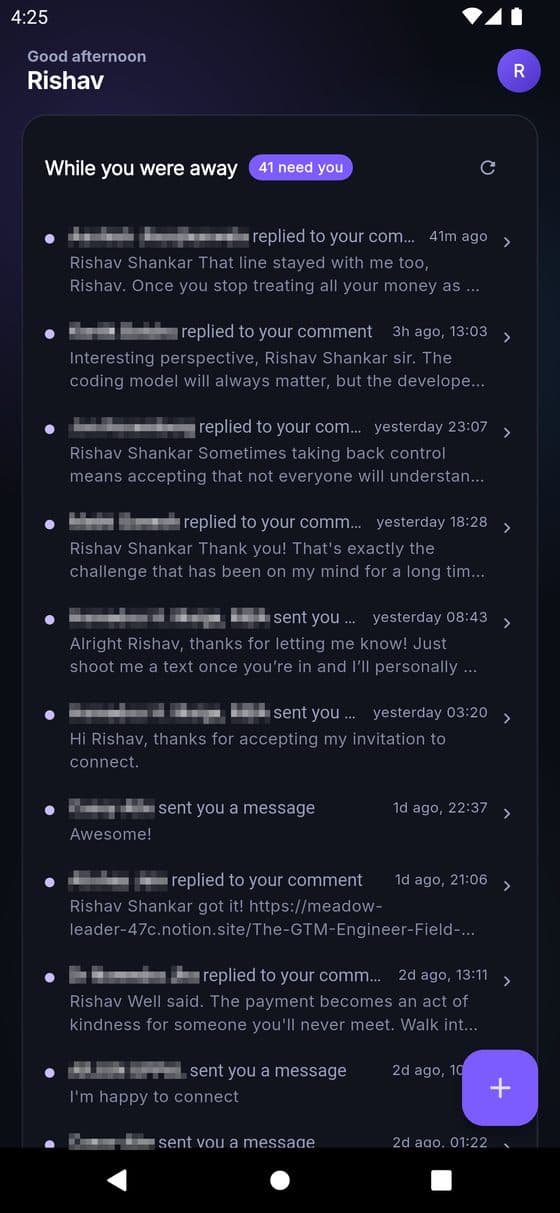
Forty one things need you

Everything that arrived since you last looked, with what the person actually said. Reactions group together, because fourteen lines of applause push the one reply that needs answering off the screen.

Sixty seven thousand, itemised

Tap: people reached

Sixty seven thousand, itemised

Every comment that earned the reach, biggest first, each one opening the post it sat under. The number stops being a claim and becomes a list you can check.

Day by day, on its own scale

Tap: followers

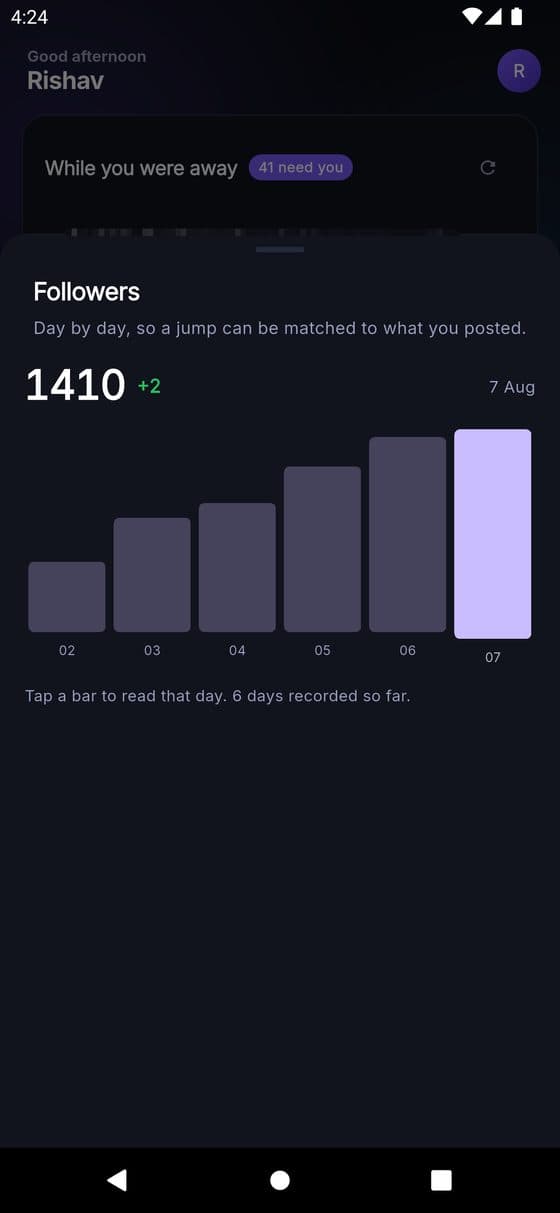
Day by day, on its own scale

1410, up two. The bars do not start at zero, because 1404 to 1409 on a zero baseline is six identical bars, and the movement is the entire question.

The full text, and three ways to answer

Tap: a reply

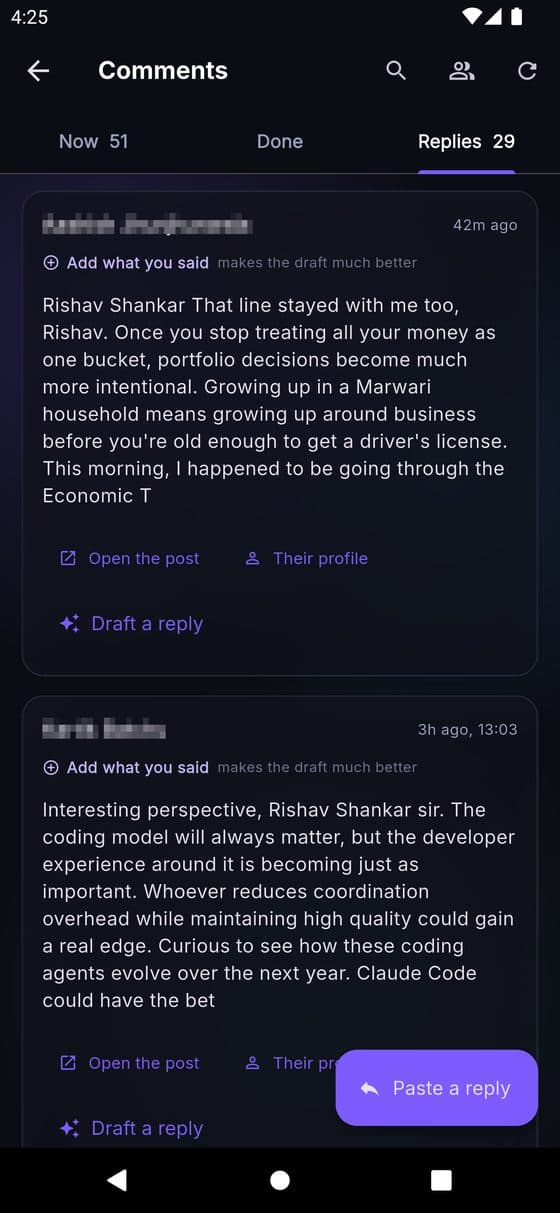
The full text, and three ways to answer

Now, Done and Replies as tabs. The whole comment, never truncated. Open the post, read their profile, or have a draft written from what you said first.

Fifty nine people, fifty one of them new

Tap: who engaged

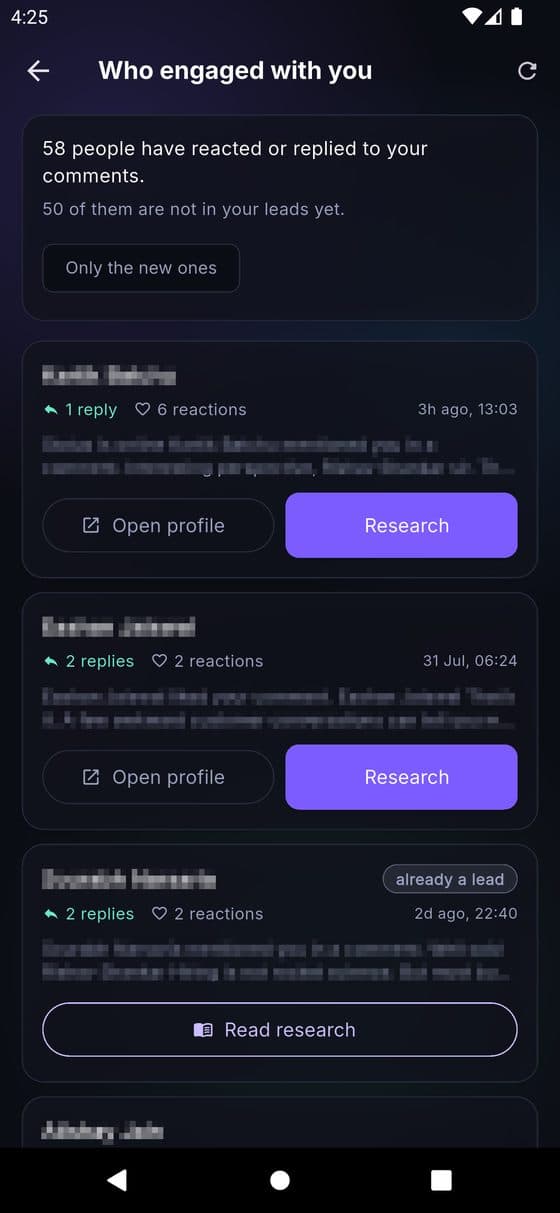
Fifty nine people, fifty one of them new

Everyone who reacted or replied, ranked. Each is one tap from research, and the ones already in your leads say so rather than sending you off to look.

The whole list, not a preview

Show all 25

The whole list, not a preview

Replies, reactions and messages in one column, newest first. A reaction and a reply look different because only one of them is a person waiting for an answer.

The part most tools leave out

What it does not do.

It does not post for you

It drafts, and you paste. A tool that comments on your behalf is a tool that will eventually embarrass you, and you will not be watching when it does.

It does not invent a case study

With no verified case studies on file, the playbook it hands to another AI explicitly says not to make up client names or results. That stays true until you add real ones.

It does not claim a number it cannot show you

Three of the home screen figures are made of comments it can name, so they open a list. The rest are LinkedIn's own totals with nothing behind them, so they open their history instead of a fabricated breakdown.

It does not hide a number that fell

A metric going down is shown going down, and you can open it to see which day. A tool that only shows numbers going up is not measuring, it is advertising.

Fit, honestly

It suits some people and genuinely does not suit others.

Built for you if

  • You sell expertise, and the buyer needs to trust you before a call
  • You already comment and post, but cannot tell what any of it returns
  • Your best conversations start from something you wrote, not a cold list
  • One wrong claim about a prospect would cost you the relationship

Look elsewhere if

  • You want volume: hundreds of connection requests a day
  • You want it to post and reply without you reading it first
  • You need a team inbox with seats, roles and shared assignment
  • You want a tool that will invent a case study to fill a gap

Before you book

The questions people actually ask.

Nothing is posted, sent or connected on your behalf. The only piece that touches LinkedIn is a watcher that reads your own notifications and activity pages in a browser you sign into yourself, and it only reads. Every message and comment leaves your account because you pasted it and pressed post.

Bring one prospect you already know well.

On the call we will research them live and you can tell us where it is wrong. That is a faster way to judge this than any deck, and if it gets them wrong you will have learned something useful about us in twenty minutes.

Built by Rian Infotech, an AI and automation studio in Noida.